If you are still looking for Certified-Data-Engineer-Professional test online materials, our products will be your good choice. We are a legal authorized enterprise offering all kinds of IT real test materials with high pass rate. Our Certified-Data-Engineer-Professional test online materials are edited by experienced experts who specialized in Databricks Databricks Certification exams. We guarantee our test questions are high passing rate and can help most candidates pass test easily. In fact we are famous by our high-quality Certified-Data-Engineer-Professional test online materials. If you are still upset about your exam, choosing us will help you half the work with double results.

We release three versions of test questions for each exam: PDF version, Soft version and Test online version. Take Certified-Data-Engineer-Professional exam for example, the questions and answers for three versions are totally same. The difference is pattern of manifestation, easy to understand and remember.
PDF version of Certified-Data-Engineer-Professional test online materials is easy to download and print. People can write on paper and practice repeatedly. It is available for companies to make presentations and communications among co-workers and candidates. Many candidates think Certified-Data-Engineer-Professional test online materials are surefooted and dependable.
Soft version of Certified-Data-Engineer-Professional test online materials is software that simulates the real tests' scenarios. You will be familiar with examination atmosphere, boost your confidence and good psychological diathesis. Certified-Data-Engineer-Professional test online materials will help users take it easy while taking part in the real test. You can set up timed test like the real test; you can use our Certified-Data-Engineer-Professional test online materials any time to test your own exam simulation test scores. Our software will remind users of practicing day to day. This software version of Databricks Certified-Data-Engineer-Professional test online materials is installed on JAVA and Windows operating system. Many candidates find our test questions are not available, as our Certified-Data-Engineer-Professional test online materials do not support downloading by Mobil Phone and Pad. Our software can be installed on multiple computers for self-paced at-your-convenience training. Our Certified-Data-Engineer-Professional test online materials can be installed more than 200 personal computers.
APP version of Certified-Data-Engineer-Professional test online materials is also client that its functions are similar with soft version. App version is much stabler than Soft version. Part of software version of Certified-Data-Engineer-Professional test online materials is not available for entering in but our APP version can. APP version of online test engine supports Windows / Mac / Android / iOS, etc. as it is the software based on WEB browser. Applicable range of APP version is wider than Soft version. Especially for exams we release great quantity of test questions, APP version of Databricks Certified-Data-Engineer-Professional test online materials will be best choice for you.
Besides good products, we provide excellent customer service. We offer 7*24 online service support about Certified-Data-Engineer-Professional test online materials. Before passing test, we will be together with every user. We believe our test questions will help candidates pass Databricks Certified Data Engineer Professional exam for sure. If you are determined to gain Databricks Certification certification, our Databricks Certified-Data-Engineer-Professional test online materials will be your best choice.
After purchase, Instant Download: Upon successful payment, Our systems will automatically send the product you have purchased to your mailbox by email. (If not received within 12 hours, please contact us. Note: don't forget to check your spam.)
Databricks Certified-Data-Engineer-Professional Exam Syllabus Topics:
| Section | Weight | Objectives |
|---|---|---|
| Topic 1: Data Sharing and Federation | ~8% | - Configure Delta Sharing and Lakehouse Federation |
| Topic 2: Developing Code for Data Processing using Python and SQL | ~22% | - Manage dependencies, libraries, and UDFs - Build pipelines with Lakeflow Spark Declarative Pipelines and Auto Loader - Implement scalable Python/SQL code and project structures |
| Topic 3: Monitoring, Logging, and Troubleshooting | ~8% | - Diagnose common pipeline and job failures - Use Spark UI, Query Profiler, and system tables |
| Topic 4: Security and Governance | ~10% | - Implement row-level security, column masking, and compliance - Manage Unity Catalog permissions and ACLs |
| Topic 5: Data Modeling | ~10% | - Design scalable Delta Lake schemas and clustering - Apply dimensional modeling techniques |
| Topic 6: CI/CD, Testing, and Deployment | ~6% | - Deploy with Declarative Automation Bundles, CLI, and REST API - Implement testing and deployment pipelines |
| Topic 7: Data Transformation, Cleansing, and Quality | ~12% | - Enforce data quality and quarantine bad data - Apply advanced Spark transformations |
| Topic 8: Cost and Performance Optimization | ~13% | - Optimize queries, clusters, and storage - Leverage system tables and observability tools |
| Topic 9: Streaming Workloads and Change Data Capture | ~11% | - Apply AUTO CDC APIs and exactly-once semantics - Implement reliable streaming pipelines |
Databricks Certified Data Engineer Professional Sample Questions:
1. A Delta Lake table in the Lakehouse named customer_parsams is used in churn prediction by the machine learning team. The table contains information about customers derived from a number of upstream sources. Currently, the data engineering team populates this table nightly by overwriting the table with the current valid values derived from upstream data sources.
Immediately after each update succeeds, the data engineer team would like to determine the difference between the new version and the previous of the table. Given the current implementation, which method can be used?
A) Parse the Delta Lake transaction log to identify all newly written data files.
B) Execute a query to calculate the difference between the new version and the previous version using Delta Lake's built-in versioning and time travel functionality.
C) Parse the Spark event logs to identify those rows that were updated, inserted, or deleted.
D) Execute DESCRIBE HISTORY customer_churn_params to obtain the full operation metrics for the update, including a log of all records that have been added or modified.
2. The data engineering team maintains the following code: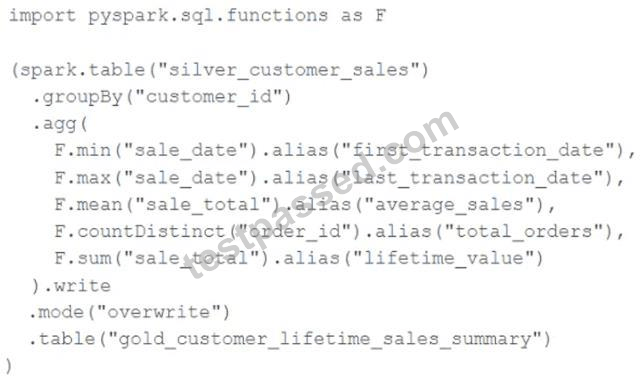
Assuming that this code produces logically correct results and the data in the source table has been de-duplicated and validated, which statement describes what will occur when this code is executed?
A) An incremental job will leverage running information in the state store to update aggregate values in the gold_customer_lifetime_sales_summary table.
B) The silver_customer_sales table will be overwritten by aggregated values calculated from all records in the gold_customer_lifetime_sales_summary table as a batch job.
C) The gold_customer_lifetime_sales_summary table will be overwritten by aggregated values calculated from all records in the silver_customer_sales table as a batch job.
D) An incremental job will detect if new rows have been written to the silver_customer_sales table; if new rows are detected, all aggregates will be recalculated and used to overwrite the gold_customer_lifetime_sales_summary table.
E) A batch job will update the gold_customer_lifetime_sales_summary table, replacing only those rows that have different values than the current version of the table, using customer_id as the primary key.
3. The data architect has mandated that all tables in the Lakehouse should be configured as external (also known as "unmanaged") Delta Lake tables.
Which approach will ensure that this requirement is met?
A) When the workspace is being configured, make sure that external cloud object storage has been mounted.
B) When data is saved to a table, make sure that a full file path is specified alongside the Delta format.
C) When a database is being created, make sure that the LOCATION keyword is used.
D) When tables are created, make sure that the EXTERNAL keyword is used in the CREATE TABLE statement.
E) When configuring an external data warehouse for all table storage, leverage Databricks for all ELT.
4. A data engineer is brining an existing production Databricks job under asset bundle management and wants to ensure that:
- The job's current configuration is captured as YAML, and all
referenced files are included in their bundle project.
- Future changes to the bundle's YAML will update the existing job in-
place (not create a new job)
How should the data engineer successfully move the production job under asset bundle management?
A) Run Databricks bundle generate job --existing-job-id to generate the YAML and download referenced files. Then, run Databricks bundle deploy to deploy the bundle, which will always update the existing job automatically.
B) Run databricks bundle generate job --existing-job-id to generate the YAML and download referenced files. Then, run Databricks bundle deployment, bind to link the bundle's job resource to the existing job in Databricks.
C) Export the job definition as JSON, convert it to YAML, and place it in your bundle. Then, run Databricks bundle deploy to update the existing job.
D) Manually create the YAML configuration for the job in your bundle project, ensuring all settings match the existing job. Then, run Databricks bundle deploy the bundle, which will update the existing job in your workspace.
5. A data engineer is tasked with ensuring that a Delta table in Databricks continuously retains deleted files for 15 days (instead of the default 7 days), in order to permanently comply with the organization's data retention policy. Which code snippet correctly sets this retention period for deleted files?
A) spark.sql("VACUUM my_table RETAIN 15 HOURS")
B) spark.sql("ALTER TABLE my_table SET TBLPROPERTIES
('delta.deletedFileRetentionDuration' = 'interval 15 days')")
C) from delta.tables import *
deltaTable = DeltaTable.forPath(spark, "/mnt/data/my_table")
deltaTable.deletedFileRetentionDuration = "interval 15 days"
D) spark.conf.set("spark.databricks.delta.deletedFileRetentionDuration", "15 days")
Solutions:
| Question # 1 Answer: B | Question # 2 Answer: C | Question # 3 Answer: D | Question # 4 Answer: B | Question # 5 Answer: B |