


[Jun 16, 2026] Fully Updated Pega Decisioning Consultant (PEGACPDC25V1) Certification Sample Questions
Latest Pegasystems PEGACPDC25V1 Real Exam Dumps PDF
NEW QUESTION # 35
A declsioning architect wants to use the customer properties Gender and MonthlyAverageUsage in a Data Join component. Which decision component is required to enable access to these properties?
- A. Data Import.
- B. Proposition Data.
- C. Set Property.
- D. None, properties are always available.
Answer: D
NEW QUESTION # 36
A customer qualifies for Standard card (priority 60), Rewards card {priority 40), and Premium card {priority 30). Standard card volume is exhausted. Rewards card has remaining volume, and Premium card has remaining volume. The system uses "Return any action that does not exceed constraint" mode.
Which actions does the customer receive in this scenario?
- A. Standard card only as highest priority action
- B. No actions due to Standard card volume exhaustion
- C. Premium card only as lowest priority available action
- D. Rewards card and Premium card as available actions
Answer: D
NEW QUESTION # 37
A revision manager needs to deploy changes from the business operations environment to production. The NBA Specialist has completed all build tasks and validated the generated artifacts. The team lead has promoted the change request to the revision manager for deployment processing.
Which step should you take to push the changes to production?
- A. Access Revision Management in Pega Customer Decision Hub portal, review the change request, and push to deployment
- B. Return the change request to the NBA Specialist for integration testing
- C. Deploy the change request to production before closing It in 1:1 Operations Manager
- D. Create a new change request to specifically address the deployment step
Answer: A
NEW QUESTION # 38
U+ Bank wants to use Pega Customer Decision Hub to show the Reward Card offer on its website to the qualified customers. In preparation, the action, the treatment, and the real-time container are already created.
As a decisioning architect, you need to verify the configurations in the Channel tab of the Next-Best-Action Designer to enable the website to communicate with Pega Customer Decision Hub.
To achieve this requirement, which two tasks do you ensure are complete in the Channel tab of the Next-Best- Action Designer? (Choose Two)
- A. Map the real-time container to a business structure level.
- B. Define the starting population.
- C. Add contact policy rules.
- D. Enable a web channel.
Answer: A,D
Explanation:
To achieve this requirement, you need to ensure that two tasks are complete in the Channel tab of the Next- Best-Action Designer: enable a web channel and map the real-time container to a business structure level. A web channel is a type of channel that allows you to deliver actions and treatments to your customers through your website or web app. You need to enable a web channel and configure its settings, such as authentication, security, and response format. A real-time container is a configuration that defines how to deliver actions and treatments to a specific channel. You need to map the real-time container that contains the Reward Card offer to a business structure level, such as Top-level or Issue-level, so that it can be available for delivery through the web channel. Verified References: [Pega Academy - Decisioning Consultant - Configuring channels],
[Pega Academy - Decisioning Consultant - Configuring real-time containers]
NEW QUESTION # 39
An outbound run identifies 150 Standard card offers, 75 on email, and 75 on the SMS channel. If the following volume constraint is applied, how many actions are delivered by the outbound run?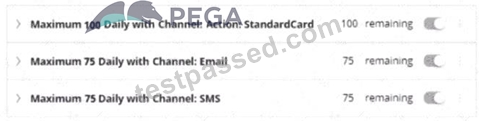
- A. 0
- B. 75 emails 25 SMSes
- C. 75 SMSes and 25 emails
- D. 1
Answer: B
Explanation:
The outbound run delivers 75 emails and 25 SMSes for the Standard card offer because the volume constraint is set to limit the number of actions per channel per day. The email channel has a limit of 75 actions per day, so all 75 email offers are delivered. The SMS channel has a limit of 25 actions per day, so only 25 SMS offers are delivered. The remaining 50 SMS offers are not delivered because they exceed the volume constraint.
NEW QUESTION # 40
The U+ Bank marketing department currently promotes various home loan offers to qualified customers.
Now, the bank does not want customers to receive more than four promotional emails per quarter, regardless of past responses to that action by the customer.
Which option allows you to implement the business requirement?
- A. Suitability rules
- B. Suppression policies
- C. Outbound channel limits
- D. Volume constraints
Answer: D
Explanation:
Volume constraints allow you to limit the number of times an action is presented to customers across one or more channels. You can use volume constraints to implement the requirement that customers do not receive more than four promotional emails per quarter, regardless of past responses to that action by the customer.
You can configure the volume constraint to limit the number of actions per channel per quarter and select the option to ignore previous responses. Outbound channel limits are used to limit the number of customers contacted per channel per run, not per quarter. Suppression policies are used to exclude customers from receiving an action based on certain conditions, such as opt-out preferences or recent purchases, not based on the number of times the action is presented. Suitability rules are used to determine whether an action is suitable for a customer based on their propensity, priority, or other criteria, not based on the number of times the action is presented.
NEW QUESTION # 41
U+ Bank, a retail bank, is facing an unforeseen technical issue with its customer care system. As a result, the bank wants to share the new temporary contact details with all customers over an SMS. All customers must receive this communication regardless of the engagement policy conditions and constraints.
Which type of communication do you configure to implement this requirement?
- A. One-time action
- B. Promotional action
- C. Mandatory action
- D. Transactional action
Answer: A
NEW QUESTION # 42
MegaRetail Solutions has successfully created and approved their brand voice in Pega 1:1 Operations Manager. They have also established global directives for style, grammar, language, and compliance. Now they want to ensure that their Pega GenAI system uses this brand voice to generate marketing treatments that also maintain consistency with their established guidelines.
How will MegaRetail Solutions' approved brand voice be applied in their content generation process?
- A. Global directives override brand voice settings for compliance requirements
- B. Brand voice applies only to manually created content, not automated generation
- C. The system uses brand voice with global directives for consistent content generation
- D. Brand voice replaces global directives for streamlined content creation
Answer: C
NEW QUESTION # 43
U+ Bank wants to use Pega Customer Decision Hub to display a credit card offer, the Standard Card, to every customer who logs in to the bank website. What three of the following artifacts are mandatory to implement this requirement7 (Choose Three)
- A. Real-time containers.
- B. Customer engagement policies.
- C. A business structure.
- D. An action and the associated web treatment.
- E. Customer contact policies.
Answer: A,C,D
Explanation:
To implement this requirement, you need to create an action and the associated web treatment, a real-time container, and a business structure. An action is a proposition that you want to present to a customer, such as a credit card offer. A treatment is the way you present the action to a customer, such as an image or a text message. A real-time container is a configuration that defines how to deliver actions and treatments to a specific channel, such as a website or a mobile app. A business structure is a hierarchy of business groups and business issues that organizes actions into meaningful categories. Verified References: Pega Academy - Decisioning Consultant - Creating actions and treatments, Pega Academy - Decisioning Consultant - Configuring real-time containers, [Pega Academy - Decisioning Consultant - Defining business structure]
NEW QUESTION # 44
As a Customer Service Representative, you present an offer to a customer who called to learn more about a new product. The customer rejects the offer. What is the next step that Pega Customer Decision Hub takes?
- A. Adds the customer to the potential churn list
- B. Stops presenting offers to the customer
- C. Sends a detailed email about the offer
- D. Reevaluates the Next-Best-Action
Answer: D
Explanation:
Pega Customer Decision Hub is a dynamic and adaptive system that constantly reevaluates the Next-Best- Action for each customer based on their interactions and feedback. If a customer rejects an offer, the system will update the customer profile and the offer performance, and then reapply the Next-Best-Action strategy to select and prioritize another offer that is more relevant and valuable for the customer. Verified References:
[Pega Decisioning Consultant | Pega Academy]
NEW QUESTION # 45
U+- Bank uses Next-Best-Action Designer to configure engagement policies for different customer segments.
A business user wants to create reusable policy conditions that can apply across multiple actions and campaigns. The user must understand when the save-to-library feature is available.
When is the save-to-library option unavailable for engagement policy conditions?
- A. When the business user configures the conditions with strategy rules or parameterized When conditions.
- B. When the business user applies conditions to group-level policies.
- C. When the business user configures the conditions with arbitration parameters.
- D. When the business user configures the conditions at the action level.
Answer: A
NEW QUESTION # 46
MyCo, a telecom company, wants to send promotional SMSs with data plan offers to their qualified customers. The business intends to use the same action flow template with their target flow pattern for all the data plan actions.
What do you configure to implement this requirement?
- A. A file template
- B. A dynamic template
- C. An output template
- D. An SMS treatment
Answer: D
NEW QUESTION # 47
What is the name of the property that the system computes automatically when you use an Adaptive Model decision component?
- A. Order
- B. Priority
- C. Rank
- D. Propensity
Answer: D
Explanation:
Propensity is the name of the property that the system computes automatically when you use an Adaptive Model decision component. Propensity is a measure of how likely a customer is to accept an action, based on their past behavior and profile. An Adaptive Model component uses machine learning to calculate the propensity for each action and store it in a property with the same name as the action. Verified References: Pega Academy - Decisioning Consultant - Using adaptive models
NEW QUESTION # 48
Regional Bank experiences an unexpected system outage affecting online banking services across multiple locations. The bank needs to immediately inform all customers about the temporary service disruption and provide alternative banking options. The communication must reach every customer simultaneously and should not be repeated.
Which communication approach should the bank use to address this urgent customer notification requirement?
- A. Configure a promotional campaign with targeted audience segmentation rules
- B. Send individual personalized messages through the standard outbound schedules
- C. Create a one-time action to deliver Immediate batch communication to all customers
- D. Schedule a regular always-on outbound communication with engagement policies
Answer: C
NEW QUESTION # 49
A bank has been running traditional marketing campaigns for many years. One such campaign sends an offer email to qualified customers on day one. On day five, the bank presents a similar offer if the first email is ignored.
If you re-implement this requirement by using the always-on outbound customer engagement paradigm, how do you approach this scenario?
- A. Configure the primary schedule to run daily and let the artificial intelligence (AI) choose the best action based on engagement policies.
- B. Create an action with a flow that contains two Send Email shapes, one for each email. Set appropriate wait times between the shapes.
- C. Create two segments to identify the target audience for each of the two offer emails: day one, and day five. Set up two schedules per day for the two segments.
- D. Configure a primary schedule for the original offer email and setup an ad-hoc schedule to send the second email.
Answer: A
Explanation:
The always-on outbound customer engagement paradigm relies on AI to select the best action for each customer at any given time, based on their profile, context, and behavior. You do not need to create separate segments or schedules for different offers or timings. You can configure the primary schedule to run daily and let the AI choose the best action based on engagement policies, such as contact policies, eligibility rules, suitability rules, and arbitration. The AI will also learn from the customer responses and optimize the action selection over time.
NEW QUESTION # 50 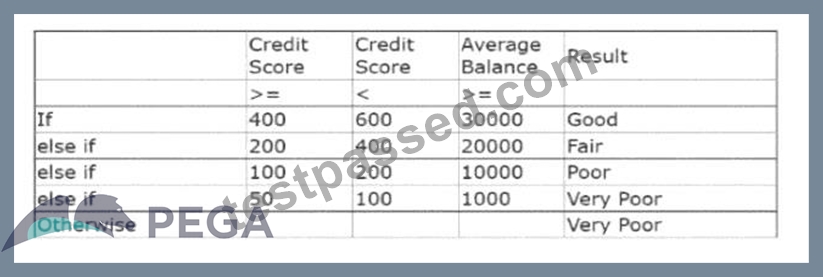
U+ Bank wants to offer credit cards only to low-risk customers. The customers are divided into various risk segments from Good to Very Poor. The risk segmentation rules that the business provides use the Average Balance and the customer Credit Score.
As a decisioning architect, you decide to use a decision table and a decision strategy to accomplish this requirement in Pega Customer Decision Hub.
Using the decision table, which label is returned for a customer with a credit score of 240 and an average balance 35000?
- A. Poor
- B. Very Poor
- C. Fair
- D. Good
Answer: A
Explanation:
Using the decision table, you can find the label for a customer with a credit score of 240 and an average balance of 35000 by following these steps:
* Start from the top row and check if the customer's credit score is less than 150. If yes, then the label is Very Poor. If no, then move to the next row.
* Check if the customer's credit score is less than 175 and their average balance is less than 25000. If yes, then the label is Poor. If no, then move to the next row.
* Check if the customer's credit score is less than 200 and their average balance is less than 50000. If yes, then the label is Fair. If no, then move to the next row.
* Check if the customer's credit score is less than 250 and their average balance is less than 75000. If yes, then the label is Good. If no, then move to the last row.
* The last row applies to all other cases that do not match any of the previous conditions. The label for this row is Very Poor.
In this case, the customer's credit score is not less than 150, so the first row does not apply. The customer's credit score is less than 175, but their average balance is not less than 25000, so the second row does not apply either. The customer's credit score is not less than 200, so the third row does not apply. The customer's credit score is less than 250 and their average balance is less than 75000, so the fourth row applies. Therefore, the label for this customer is Poor.
NEW QUESTION # 51
U+ Bank observes that some customers receive the same credit card offer multiple times within a short period, which results in dissatisfaction. The bank wants to suppress a specific credit card offer if it has been shown three times within seven days.
What should you configure in the Contact Policy to prevent a specific credit card offer from being shown to a customer more than three times in seven days?
- A. Set the Tracking Level to Action and the Outcome Type to Impressions.
- B. Set the Tracking Level to Group and the Outcome Type to Clicks.
- C. Set the Tracking Level to Action and the Outcome Type to Clicks.
- D. Set the Tracking Level to Group and the Outcome Type to Impressions.
Answer: A
NEW QUESTION # 52
An outbound run identifies 150 Standard card offers, 75 on email, and 75 on the SMS channel. If the following volume constraint Is applied, how many actions are delivered by the outbound run?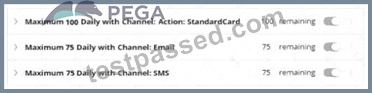
- A. 0
- B. 75 emails 25 SMSes
- C. 1
- D. 75 SMSes and 25 emails
Answer: C
NEW QUESTION # 53
......
Pegasystems PEGACPDC25V1 Dumps - Secret To Pass in First Attempt: https://lead2pass.testpassed.com/PEGACPDC25V1-pass-rate.html