


[Mar 27, 2026] Fast Exam Updates B2C-Commerce-Architect dumps with PDF Test Engine Practice
Exam Valid Dumps with Instant Download Free Updates
Salesforce Certified B2C Commerce Architect certification is a valuable credential for architects who want to demonstrate their expertise in designing and architecting B2C Commerce solutions. It helps candidates stand out in the job market and opens up new career opportunities. With the growing demand for B2C Commerce solutions, this certification is becoming increasingly important for architects who want to stay ahead of the competition.
NEW QUESTION # 34
Northern Trail Outfitters (NTO) wants to use Marketing Cloud to implement an Abandoned Cart Solution Workflow so that personalized messages are sent to shoppers who add items to their cart but abandon the B2C Commerce storefront.
Which two options should a Solution Architect recommended to meet this requirement? Choose 2 answers
- A. Configure streaming updates for catalog importing, implement Google Analytics tracking, and leverage Journey Builder to trigger an abandoned cart message.
- B. Configure streaming updates for catalog importing, implement the Collect Tracking Code, and leverage Journey Builder to trigger an abandoned cart message.
- C. Configure B2C Commerce catalog, product, inventory, and customer data feeds; implement Marketing Cloud collect.js and trigger an abandoned cart message through
- D. Configure B2C Commerce catalog, product, order, and customer data feeds; implement Marketing Cloud collect.js and trigger an abandoned cart message through Journey Builder.
Answer: A,D
Explanation:
Journey Builder.
NEW QUESTION # 35
A company manages its regional operations asseparate businesses. The regional sites (Site A and Site B) operate with:
* Separate realms
* Deferent code bates
* Different category navigation menus
* Frequent updates on category structure
The requirement from the business is to provide hreflang link tags on category pages pointing to the same category on the other regional site. Example MTML for one of these links as displayed on Site A is:
Which solution should the Architect choose while keeping performance in mind?
- A. Create a custom Business Manager module. Ask the business to maintain the hreflang link tags for each regional site in this Business Manager module.
- B. Create a new custom object type Populate the hreflang mapping for each category and locale in this custom object. Use the custom object to display the hreflang link tag.
- C. Create additional locales in al realms create a new custom attribute on the category that is localized.
Populate the attribute with the other site URLs and use it to display the hreflang tag. - D. Create a new customattribute on the Category. Populate the attribute with the other entire site URLs corresponding to locales In JSON Format. Use the attribute to display the hreflang link tag.
Answer: B
Explanation:
For a multi-regional setup with different realms and frequent updates, using a custom object to manage hreflang mappings offers flexibility and scalability. Custom objects can efficiently store URL mappings for each category across different locales, making it easier to manage and update as category structures change.
This method allows for centralized control over hreflang mappings and simplifies maintenance compared to other options which might involve more complex integrations or manual updates.
NEW QUESTION # 36
During code review, the Architect found that there is a service call on every visit of the product detail woe (PDP).
What best practices should the Architect ensure are followed for the service configuration?
Choose 2 answers
- A. Service mock up call is configured.
- B. Service timeout is set.
- C. Service logging is disabled.
- D. Circuit breaker is enabled.
Answer: B,D
NEW QUESTION # 37
A third party survey provider offers both an API endpoint for individual survey data and an SFTP server endpoint that can accept batch survey data. The initial implementation of the integration includes
1. Marking the order as requiring a survey before order placement
2. On the order confirmation pace, the survey form is displayed for the customer to fill
3. The data is sent to the survey provider API, and the order it marked as not requiring a survey Later it was identified that this solution is not fit for purpose as the following issues and additional requirements were identified:
1. If the API call fails, the corresponding survey data is lost. The Business requires to avoid data loss.
2. Some customers skipped the form. The Business require sending a survey email to such customers.
3. The Order Management System (OMS) uses a non-standard XML parser it did not manage to parse orders with the survey, until the survey attribute was manually removed from the xml.
How should the Architect address the issues and requirements described above?
- A. Create a custom session attribute when the survey is required. Send to the API endpoint in real-time. On failure, capture the survey data in the session and reprocess, use me session attribute to send emails for the cases when survey was skipped.
- B. Create a custom object when the survey is required Send to the API endpoint in real-time. On success, remove the object. On failure, capture the survey data in the custom object and later reprocess with a job. Use the custom object to send emails for the cases when survey was skipped.
- C. Send the survey data to the API endpoint in real-time until the survey data is successfully captured.
Instruct the OMS development team to update their XML parser, use the Order survey attribute to send emails for the cases when the survey was skipped. - D. Create a custom object to store the survey data. Send to the API endpoint using a job. On success, remove the custom object. On failure, send the survey data with API from the next execution of the same job. Use the custom object to send emails for the cases when the survey was skipped.
Answer: B
NEW QUESTION # 38
An Architect has been asked by the Business to integrate a new payment LINK cartridge. As part of the integration, the Architect has created four new services to access various endpoints in the integration.
How can the Architect move the new services to Production when the integration is ready for launch?
- A. The new services will be moved to Production with a Code Replication.
- B. The new services will be moved to Production with a Data Replication.
- C. The new services will be moved to production with a Site Import.
- D. The new services must be manually exported from staging and Imported into Production.
Answer: D
NEW QUESTION # 39
A client is planning to migrate its e-commerce to Salesforce Commerce Cloud. Their expectation is to increase the business volume by 300%. As an architect you decide before go-live execute a load testing in order to check that the new site will fit client expectations. This table show the results of test execution: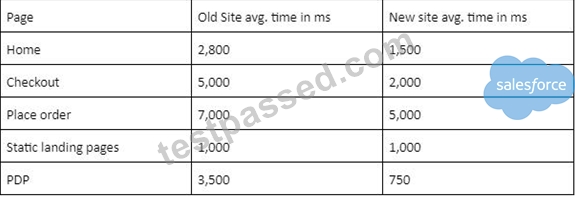
* 500 http error appears twice during search refinement and 404 is shown while accessing an specific PDP. According to the results shown above, how can we evaluate the load test?
- A. Go live must be postponed until those 400/500 errors will be fixed.
- B. There are two blockers. Go live must be postponed until checkout and place order average time is under 1,500 milliseconds. Otherwise a lot of purchases will be lost.
- C. We can proceed with the go live. All key performance indicators are now better than in the old site even with 300% more volume.
- D. In general it is pretty good, the new site will work as expected. We can proceed with the go live and after that some improvements on place order should be done.
Answer: A
NEW QUESTION # 40
The Home-Show route uses this middleware chain:
The developer added Home.;s in another cartridge, which is before the original cartridge in the cartridge path, to extend that route but it does not have the middleware chain: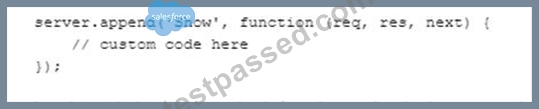
Assuming the code is correct on both functions, what is the expected result?
- A. The base code executes and then the custom code executes.
- B. The custom code executes and then the base code executes.
- C. A RunTime error is thrown, "Error: Params do not match route".
- D. The base code executes, but the custom code is ignored because the signature lines do not match.
Answer: C
NEW QUESTION # 41
The Client has requested an Architect's help in documenting the architectural approach to a new home page.
The requirements provided by the business are:
* Multiple areas of static image content, some may need text shown at well
* The content page must be Realizable
* A carousel of featured products must be shown below a banner 101191
* Recommended categories will be featured based on the time of year
Which two solutions would fulfil these requirements?
Choose 2 answers
- A. Leverage B2C Commerce content slots and assets
- B. Leverage B2C Commerce locales in Business Manager
- C. Leverage B2C Commerce Pege Designer with a dynamic layout.
- D. Leverage B2C Commerce Content Management Service
Answer: B,C
NEW QUESTION # 42
An ecommerce site has dynamic shipping cost calculation. it allows the customers to see their potential shipping costs on the Product Detail Page before adding an item to the cart.
For this feature, shipping touts are calculated using the following logic:
* Set the shipping method on the Basket
* Add the item to the basket, calculate the basket total and get the shipping cost for this method
* Remove the item from the Basket to restore the original state
* The above process is repeated for each shipping method
During the testing it was discovered that the above code violates the spi.basket.addResolveInSameResquest quota.
What should the Architect do to resolve this issue and maintain the business requirement?
- A. Omit the removal of the Item and speed up the process for the customer by adding the product to the basket for them.
- B. Wrap the adding of product and shipping cost calculation in a transaction which Is then rolled back to restore the original state
- C. Wrap each Individual step of the process its own transaction Instead of using one transaction for all steps.
- D. Omit the calculation of shipping cost until the customer is ready to check out and has chosen the shipping method they want to
Answer: B
NEW QUESTION # 43
A business wants to migrate its customer service provider from provider A to provider B. Provider e offers a LINK cartridge to integrate with its commerce solution.
Which three artifacts need to be created by the Architect? Choose 3 answers
- A. Document the customizations required on top of the LINK cartridge based on current commerce implementation and business needs.
- B. Document the design of implementing a new B2C Commerce cartridge following the Industry standard best practices
- C. Document the data mapping between commerce and customer service provider.
- D. Document how the customer online journey flown from landing on the page to placing of the order
- E. Document the data objects, the interface, and data synchronization frequency between the systems.
Answer: A,C,E
NEW QUESTION # 44
A B2C Commerce Developer has just finished implementing a new promotion code form on checkout. During review, an Architect notes that the form it not using CSRF validation correctly.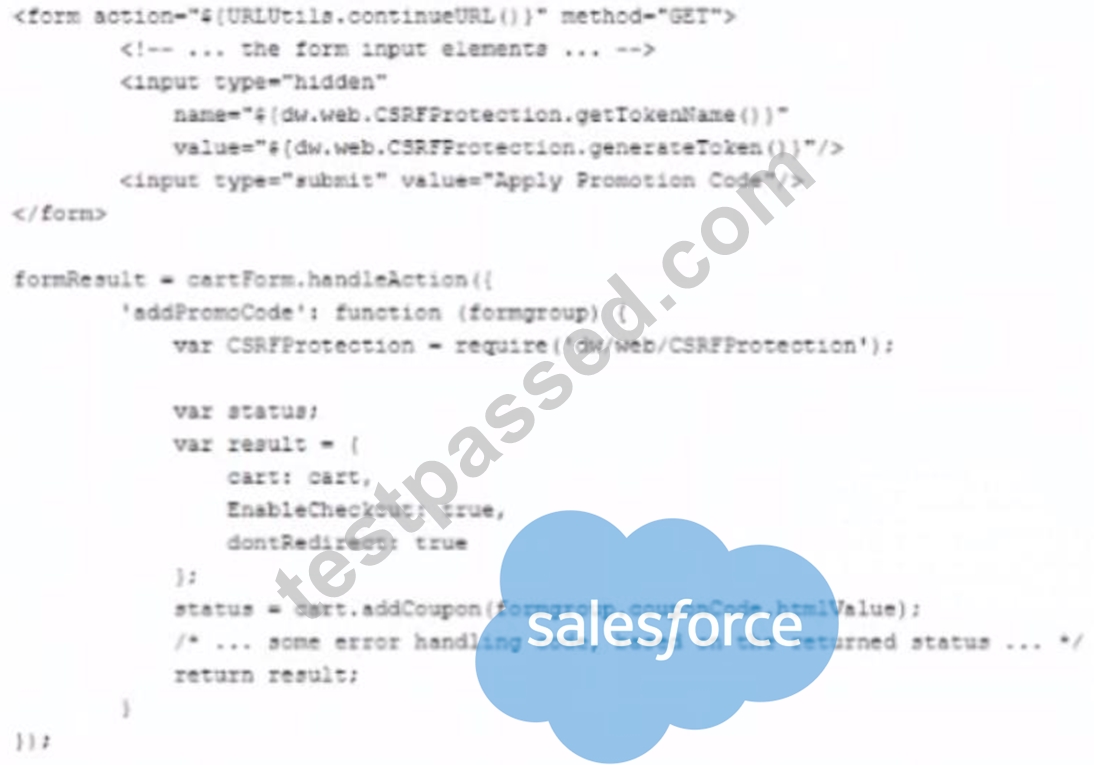
Which two options are best practice recommendations for dealing with CSRF validation? Choose 2 answers
- A. Automatically renew the CSRF Token if expired.
- B. Only use POST methods over HTTPS.
- C. Ensure the CSRF protection is validated on form submission.
- D. Only use GET methods over HTTPS.
Answer: B,C
Explanation:
For implementing CSRF (Cross-Site Request Forgery) protection correctly, especially in forms like promotion code submissions during checkout, best practices include:
Option A (Ensure the CSRF protection is validated on form submission): It is crucial to validate the CSRF token upon the form's submission to ensure that the request originates from a legitimate source and corresponds to the user's intended actions, enhancing security against CSRF attacks.
Option D (Only use POST methods over HTTPS): Using POST methods for transmitting form data helps mitigate the risk of CSRF attacks as opposed to GET methods which can be manipulated more easily via URL. Ensuring the communication is over HTTPS encrypts the transmission, securing the data from interception or tampering during transit.
These practices safeguard against common security vulnerabilities and ensure that the application adheres to secure coding standards.
NEW QUESTION # 45
You're in charge of Pipeline migration to Controllers. What should be the best approach to do it in order to avoid poor performance and using Pipelines and controllers together until all migration is done?
- A. To reduce risk of circular dependencies and for easier migration mix pipelines and controllers in a single cartridge.
- B. onRequest and onSession pipelines are replaced with the OnRequest and OnSession hooks.
- C. Use the same name for new Controllers than pipelines because it will be easy to identify that is migrated and Controllers take precedence. Furthermore it will be a good practice to do it in separate cartridges.
- D. Controllers and pipelines must be in the same folder to avoid collisions between them.
Answer: B,C
NEW QUESTION # 46
During the discovery phase the client tells you that certain categories for the storefront will need dynamic categorization. What is the best approach to list under "New products" category the products that have been online less than 30 days in the website.
- A. None of these options are valid even though they scale in large catalogs. Dynamic categorization is not available OOTB in Salesforce Commerce Cloud.
- B. None of these options are valid because this may not scale if used widely in a large catalog even though caching may prevent the storefront from hitting the search engine too hard.
- C. Create a new Search Refinement for "New products". To display products according products.activeData.daysAvailable
- D. Create a new sorting rule with products.activeData.daysAvailable for "New products" category.
Answer: A
NEW QUESTION # 47
A new version of the Page Show controller is required for implementation of Page Deserter specific look. It requires implementation of a specific, cache period for Page Designer pages, which b not currently available in the base Storefront Reference Architecture (SFRA) cache.js module What two steps should the Architect instruct the developer to implement?
Choose 2 answers
- A. Create new cache,js in client's cartridge. Extend cache,js from app_storefront_base and add a function for the Page Designer caching.
- B. Create new ceche,js client's cartridge. Copy cache,js from app_storefront_base and add a function for the Page Designer caching.
- C. Create new Page.js controller in client s cartridge. Copy code from base and modify the Page-Show route to include the new cache middleware function.
- D. Create new Page,js controller in client's cartridge. Extend the code from base and prepend the new cache middleware function to Page-Show route.
Answer: A,D
NEW QUESTION # 48
A multi-brand company uses B2C Commerce, Service Cloud, and Marketing Cloud and is seeking an order management solution. They process 2,000 orders per hour across their brands. The company has one B2C Commerce realm, two Salesforce core orgs, and two Marketing Cloud business units. The company is choosing between these three options for an order management tool:
* Build an order management solution in B2C Commerce using order management APIs
* Purchase Salesforce Order Management
* Build a custom order management solution using their own development team Which three statements should a Solution Architect use to support using the Salesforce Order Management solution?
Choose 3 answers
- A. Salesforce Order Management synchronizes orders to and from B2C Commerce, which essentially replaces the Service Cloud Connector.
- B. The existing Service Cloud implementation team could extend the Salesforce Order Management product to the existing org.
- C. Salesforce Order Management shares the same database with Service Cloud while other solutions need to build additional integration.
- D. Salesforce Order Management is a productized connector solution between B2C Commerce and Service Cloud; orders will be synchronized from the client B2C Commerce realm to multiple Salesforce Orgs without the need for customization.
- E. B2C Commerce order management does not support complex or advanced use cases.
Answer: B,D,E
NEW QUESTION # 49
An Architect isperforming an audit of production logs via Log Center and finds some potentially dangerous custom log output.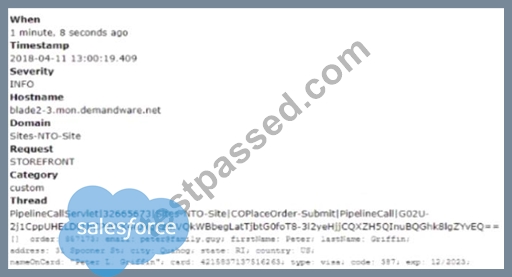
In which two ways It this log output Improper In a production environment? Choose 2 answers
- A. The log information includes the customer's card CW (card security code) and expiration date, which violates PCI.
- B. The log information includes the order number and customer s email, which violates PCI.
- C. Information logs should not be used in a production environment
- D. The log information includes the customer s cardname as it appears along with the credit card number (PAN), which violates PCI.
Answer: B,D
Explanation:
In a production environment, logging sensitive customer information such as credit card details (PAN, CVV, expiration date) can lead to severe security and compliance issues, specifically violating PCI DSS (Payment Card Industry Data Security Standard) requirements. The standards strictly prohibit the storage of CVV codes and mandate that any PAN displayed must be masked. Storing such data in logs is not only a risk for data breaches but also non-compliance with these standards can lead to penalties.
* Option A: Including the customer's card name along with the full credit card number in logs is a clear violation of PCI DSS requirements, which stipulate that no more than the last four digits of the card number may be displayed.
* Option B: Logging the card security code (CVV) and expiration date is explicitly prohibited by PCI DSS, which requires that sensitive authentication data, including CVV, must never be stored post- authentication, even if it is encrypted.
NEW QUESTION # 50
......
Download B2C-Commerce-Architect Exam Dumps PDF Q&A: https://lead2pass.testpassed.com/B2C-Commerce-Architect-pass-rate.html