


Prepare for the Actual CrowdStrike CCIS IDP Exam Practice Materials Collection
CrowdStrike CCIS Certified Official Practice Test IDP - Jun-2026
NEW QUESTION # 22
Which entity tab will show an administrator how to lower the account's risk score?
- A. Risk
- B. Activity
- C. Timeline
- D. Asset
Answer: A
Explanation:
In CrowdStrike Falcon Identity Protection, theRisktab within a user or account entity provides administrators with direct visibility intowhy an account has a specific risk score and what actions can be taken to reduce that score. This functionality is a core component of theUser AssessmentandRisk Assessmentsections of the CCIS (CrowdStrike Identity Specialist) curriculum.
The Risk tab aggregates bothanalysis-based risksanddetection-based risks, clearly identifying contributing factors such as compromised passwords, excessive privileges, risky authentication behavior, stale or never- used accounts, and policy violations. It also highlights theseverity, likelihood, and consequenceof each risk factor, allowingadministrators to prioritize remediation efforts effectively. Most importantly, this tab provides actionable guidance, enabling teams to understand which specific remediation steps-such as enforcing MFA, resetting credentials, reducing privileges, or disabling unused accounts-will directly lower the account's overall risk score.
Other entity tabs do not provide this capability. TheTimelinetab focuses on chronological events and detections, theActivitytab displays authentication and behavioral activity, and theAssettab shows associated endpoints and resources. Only theRisktab is designed to explain risk drivers and guide remediation, making Option Dthe correct and verified answer.
NEW QUESTION # 23
To enforce conditional access policies with Identity Verification, an MFA connector can be configured for different authentication methods such as:
- A. Page
- B. Push
- C. Pull
- D. Alarm
Answer: B
Explanation:
Falcon Identity Protection integrates with third-party MFA providers throughMFA connectorsto support conditional access and identity verification. The CCIS documentation explains that these connectors allow organizations to enforce MFA challenges based on identity risk, authentication behavior, or policy conditions.
One of the supported MFA authentication methods isPush, where a notification is sent to a registered device or application for user approval. Push-based MFA is widely used due to its balance of usability and security and is fully supported by Falcon Identity Protection when integrated with compatible MFA providers.
The other options are not valid MFA authentication methods within Falcon:
* Page and Pull are not recognized MFA mechanisms.
* Alarm is related to alerting, not authentication.
By enabling push-based MFA through an MFA connector, organizations can dynamically enforce identity verification in alignment with Zero Trust principles. Therefore,Option Bis the correct and verified answer.
NEW QUESTION # 24
Which of the following MFA providers areNOTsupported by Falcon Identity?
- A. Firebase
- B. Symantec VIP
- C. Azure (Entra) MFA
- D. DUO
Answer: A
Explanation:
Falcon Identity Protection integrates with a defined set ofsupported MFA providersto enforce identity verification and conditional access based on identity risk. According to the CCIS curriculum, supported MFA providers includeAzure (Entra) MFA,Cisco Duo, andSymantec VIP, which are commonly used enterprise- grade MFA solutions.
These integrations allow Falcon Identity Protection to evaluate authentication attempts and dynamically enforce MFA challenges when risky behavior is detected. The supported providers expose the necessary APIs and authentication workflows required for Falcon to trigger MFA challenges as part of Policy Rules and Zero Trust enforcement.
Firebaseis not a supported MFA provider within Falcon Identity Protection. Firebase is primarily a mobile and application development platform and does not function as an enterprise MFA provider compatible with Falcon's identity enforcement model. As such, it cannot be used to enforce conditional access or identity verification through Falcon Identity Protection.
Because Falcon only supports specific, enterprise MFA integrations validated by CrowdStrike,Option Ais the correct and verified answer.
NEW QUESTION # 25
What is the recommended action for the"Guest Account Enabled"risk?
- A. Apply a policy rule with an "Access" trigger and "Block" action on the Guest account
- B. Disable Guest accounts on all endpoints
- C. Add related endpoints to a watchlist
- D. Disable the endpoint in Active Directory
Answer: B
Explanation:
In Falcon Identity Protection, the"Guest Account Enabled"risk highlights the presence of local or domain guest accounts that remain active across endpoints. Guest accounts are inherently high-risk because they typically lack strong authentication controls, are rarely monitored, and are frequently abused by attackers for lateral movement and persistence.
The CCIS curriculum explicitly recommendsdisabling Guest accounts on all endpointsas the primary remediation action. This is because guest accounts often bypass standard identity governance processes and violate the principles ofleast privilegeandZero Trust, both of which are foundational to Falcon Identity Protection's security model. Disabling these accounts removes an unnecessary and dangerous authentication path from the environment.
Other options are incorrect because:
* Adding endpoints to a watchlist does not remediate the risk.
* Blocking access via a policy rule is less effective than eliminating the account entirely.
* Disabling endpoints in Active Directory does not directly address the guest account exposure.
Falcon Identity Protection prioritizeselimination of weak identity configurations, and disabling guest accounts is a direct, effective action that immediately lowers identity risk scores and reduces attack surface.
Therefore,Option Cis the correct and verified answer.
NEW QUESTION # 26
For false positives, the Detection details can be set to new"Actions"using:
- A. remediations
- B. recommendations
- C. exceptions
- D. exits
Answer: C
Explanation:
When an identity-based detection is determined to be afalse positive, Falcon Identity Protection allows administrators to take corrective action usingexceptions. According to the CCIS curriculum, exceptions are the mechanism by which detections can be suppressed for specific entities or conditions without disabling the detection entirely.
Exceptions are configured from theDetection detailsview and are intended to handle known, acceptable behavior that would otherwise continue to trigger detections. This allows security teams to reduce noise while maintaining visibility into true threats. Exceptions are especially valuable in environments with complex authentication patterns or legacy configurations.
The other options are incorrect:
* Exitsare not a detection control mechanism.
* Remediationsrefer to corrective actions, not suppression logic.
* Recommendationsprovide guidance but do not change detection behavior.
By usingexceptions, Falcon ensures that false positives are handled in a controlled and auditable way, aligning with best practices outlined in the CCIS material. Therefore,Option Cis the correct answer.
NEW QUESTION # 27
How should a user be classified if one requires observation for potential risk to the business?
- A. Marked User
- B. Honeytoken Account
- C. High Risk
- D. Watched User
Answer: D
Explanation:
Within Falcon Identity Protection, aWatched Useris a user explicitly designated forheightened monitoring due to potential business risk. According to the CCIS curriculum, watchlists are designed to provide additional visibility into users whose behavior, access level, or role may warrant closer observation, even if they have not yet exhibited confirmed malicious activity.
Watched Users may include executives, administrators, users with access to sensitive systems, or accounts suspected of being targeted. Placing a user on a watchlist does not imply compromise; instead, it ensures their activity is prioritized in investigations, detections, and dashboards.
The other options are incorrect:
* Honeytoken Accountsare decoy accounts designed to detect malicious usage.
* High Riskis a calculated risk state, not a monitoring classification.
* Marked Useris not a valid Falcon Identity Protection classification.
Because the CCIS material explicitly identifiesWatched Usersas accounts requiring observation for potential risk,Option Cis the correct and verified answer.
NEW QUESTION # 28
What setting can be switched under the Domain Security Overview for each Active Directory domain and/or Azure tenant?
- A. Scope
- B. Domains
- C. Privileged Identities
- D. Goal
Answer: A
Explanation:
In the Domain Security Overview,Scopeis a configurable setting that allows administrators toswitch between Active Directory domains and Azure tenants. This capability is essential for organizations managing multiple identity environments, as it enables targeted risk assessment and comparison across different identity infrastructures.
The CCIS documentation explains that Scope determineswhich domain or tenant's identity data is displayedin the Overview dashboard, including risk scores, trends, and prioritized remediation guidance.
Changing the scope does not alter risk calculations; it simply refocuses the analysis on the selected identity environment.
Other options are incorrect because:
* Privileged Identities represent a subset of users, not a switchable setting.
* Domains are entities, not a dashboard control.
* Goal changes how risks are evaluated, not which environment is displayed.
By allowing granular control over which domain or tenant is analyzed, Scope supports accurate identity risk management in complex, hybrid environments. Therefore,Option Dis the correct answer.
NEW QUESTION # 29
By using compromised credentials, threat actors are able to bypass theExecutionphase of the MITRE ATT&CK framework and move directly into:
- A. Discovery
- B. Lateral Movement
- C. Initial Access
- D. Weaponization
Answer: A
Explanation:
The CCIS curriculum highlights a critical identity-security concept: when attackers usecompromised credentials, they often bypass traditional malware-based attack phases, including theExecutionphase of the MITRE ATT&CK framework. Because no malicious code needs to be executed, attackers can immediately begin interacting with the environment as a legitimate user.
As a result, threat actors move directly into theDiscoveryphase. During Discovery, attackers enumerate users, groups, privileges, systems, domain relationships, and trust paths to understand the environment and plan further actions. This behavior is commonly observed in identity-based attacks and living-off-the-land techniques.
Falcon Identity Protection is specifically designed to detect this behavior by monitoring authentication traffic, privilege usage, and anomalous identity activity-areas where traditional EDR tools may have limited visibility.
The other options are incorrect:
* Initial Access has already occurred via credential compromise.
* Weaponization and Execution are not required.
* Lateral Movement typically follows Discovery.
Because compromised credentials allow attackers to jump straight intoDiscovery,Option Cis the correct and verified answer.
NEW QUESTION # 30
Falcon Identity Protection monitors network traffic to build user behavioral profiles to help identify unusual user behavior. How can this be beneficial to create a Falcon Fusion workflow?
- A. Falcon Fusion will only work with certain users
- B. Falcon Fusion will only send emails to the user
- C. Falcon Fusion is not identity based
- D. Falcon Fusion works with your IT policy enforcement through the use of identity and behavioral analytics
Answer: D
Explanation:
Falcon Identity Protection continuously inspects authentication traffic and network behavior to establish behavioral baselines for users and accounts. These baselines enable the platform to detect deviations that indicate potential compromise, misuse, or insider threat activity. This behavioral intelligence directly enhances the effectiveness ofFalcon Fusion workflows.
Falcon Fusion leveragesidentity and behavioral analyticsas decision points within workflows, allowing automated actions to be triggered when abnormal behavior is detected. For example, a workflow can automatically enforce MFA, notify administrators, isolate risky sessions, or initiate remediation when a user deviates from their established baseline.
The CCIS curriculum highlights that Falcon Fusion is designed tointegrate identity risk signals with IT policy enforcement, enabling Zero Trust-aligned automation. This capability goes far beyond simple notifications and supports coordinated responses across security and IT teams.
Options A, B, and C are incorrect because Falcon Fusion is fully identity-aware, applies broadly across users and entities, and supports a wide range of actions beyond email notifications. Therefore,Option Daccurately describes how behavioral profiling strengthens Falcon Fusion workflows.
NEW QUESTION # 31
Where in the Identity Protection module can one view the monitoring status of domain controllers?
- A. System Notifications
- B. Domains
- C. Connectors
- D. Settings
Answer: B
Explanation:
In Falcon Identity Protection, theDomainspage is where administrators can view themonitoring and health status of domain controllers. The CCIS curriculum explains that this page provides visibility into which domain controllers are actively reporting authentication traffic, their inspection status, and whether Authentication Traffic Inspection (ATI) is enabled.
This view is essential for validating coverage and ensuring that Falcon Identity Protection has sufficient visibility into domain authentication activity. Administrators can quickly identify gaps, such as domain controllers that are not reporting or are misconfigured, and take corrective action.
The other options serve different purposes:
* Settingsmanage general configuration.
* System Notificationsdisplay alerts and messages.
* Connectorsmanage integrations such as MFA and IDaaS.
Because domain controller visibility and monitoring health are managed at the domain level,Option C (Domains)is the correct and verified answer.
NEW QUESTION # 32
Which of the following demonstrates a detection is enabled?
- A. The detection has an Enabled tag next to it
- B. The toggle next to the Detection Enabled is marked in green
- C. The toggle next to the Detection Enabled is marked in gray
- D. The detection has a Disabled tag next to it
Answer: B
Explanation:
In Falcon Identity Protection, detection status is visually indicated using atoggle controlwithin the detection configuration interface. According to the CCIS documentation, when a detection isenabled, the toggle next to Detection Enabledis displayed ingreen.
A green toggle indicates that the detection logic is active and that Falcon will generate detections when the defined conditions are met. When the toggle is gray, the detection is disabled and will not generate alerts or contribute to incident formation.
Falcon does not rely on textual "Enabled" or "Disabled" tags to indicate detection status. Instead, the toggle color provides a clear, immediate visual indicator to administrators.
Because agreen toggleexplicitly represents an enabled detection,Option Bis the correct and verified answer.
NEW QUESTION # 33
Falcon Identity Protection can continuously assess identity events and associate them with potential threats WITHOUTwhich of the following?
- A. Machine-learning-powered detection rules
- B. Ingesting logs
- C. API-based connectors
- D. The need for string-based queries
Answer: D
Explanation:
Falcon Identity Protection is architected as alog-free identity security platform, a core tenet emphasized throughout the CCIS curriculum. Unlike traditional SIEM- or log-based solutions, Falcon Identity Protection doesnot require string-based queriesto continuously assess identity events or associate them with threats.
Instead, the platform relies onmachine-learning-powered detection rules,real-time authentication traffic inspection, andAPI-based connectorsto collect and analyze identity telemetry directly from domain controllers and identity providers. This approach eliminates the operational complexity of building, tuning, and maintaining query logic.
String-based queries are commonly associated with legacy log aggregation tools and SIEM platforms, where analysts must manually search logs to identify suspicious behavior. Falcon Identity Protection replaces this model withbehavioral baselining and automated correlation, enabling continuous identity risk assessment without human-driven query execution.
Because Falcon does not require string-based queries to operate,Option Dis the correct and verified answer.
NEW QUESTION # 34
What trigger will cause a Falcon Fusion Workflow to activate from Falcon Identity Protection?
- A. New endpoint detection
- B. New incident
- C. Alert > Identity detection
- D. Spotlight user action > Host
Answer: C
Explanation:
Falcon Fusion workflows integrate directly with Falcon Identity Protection throughidentity-based triggers, allowing automated responses to identity threats. The correct trigger that activates a Falcon Fusion workflow from Identity Protection isAlert > Identity detection.
Identity detections are generated when Falcon observes suspicious or malicious identity behavior, such as credential abuse, abnormal authentication patterns, lateral movement attempts, or policy violations related to identity risk. These detections are distinct from endpoint-only detections or incidents and are specifically designed to representidentity-based attack activity.
WhileNew incidentandNew endpoint detectionare valid Falcon Fusion triggers in other Falcon modules, they are not the primary triggers for identity-focused automation. Similarly,Spotlight user action > Host relates to vulnerability management workflows rather than identity analytics.
The CCIS curriculum emphasizes that Falcon Fusion enablesautomated identity response, such as notifying security teams, disabling accounts, enforcing MFA, or triggering SOAR actions, based onidentity detections.
Therefore, workflows tied toAlert > Identity detectionallow organizations to respond quickly and consistently to identity threats, makingOption Cthe correct answer.
NEW QUESTION # 35
Within the Falcon Identity Protection portal, which page allows you to enable/disable Policy Rules?
- A. Enforce
- B. Identity-Based Detections
- C. Configure
- D. Policy Enforcement
Answer: A
Explanation:
In Falcon Identity Protection, Policy Rules are managed within the Enforce section of the portal. The CCIS documentation explains that Enforce is the operational area where administrators create, enable, disable, and manage Policy Rules and Policy Groups.
This section is specifically designed for identity enforcement logic, allowing security teams to activate or suspend rules without modifying underlying configurations or analytics. Enabling or disabling a Policy Rule immediately affects how identity conditions are enforced across the environment.
Other sections serve different purposes:
Configure manages connectors, domains, subnets, and risk settings.
Identity-Based Detections is used for investigation and monitoring.
Policy Enforcement is not a standalone navigation section in Falcon Identity Protection.
Because rule activation and enforcement control reside exclusively in Enforce, Option B is the correct and verified answer.
NEW QUESTION # 36
The Enforce section of Identity Protection is used to:
- A. Gain an overview of the domain and indicate whether the domain follows best security practice
- B. Define policy rules that determine what actions to take in response to certain triggers observed in the environment
- C. View all identity-based detections and identity-based incidents in the environment
- D. Configure domains, appliances, subnets, connectors, risk configuration, and settings
Answer: B
Explanation:
The Enforce section of Falcon Identity Protection is dedicated to policy-based identity enforcement.
According to the CCIS curriculum, this section allows administrators to define and manage Policy Rules and Policy Groups that specify how the platform should respond when identity-related conditions are detected.
These rules evaluate triggers such as risky authentication behavior, privilege misuse, compromised credentials, or elevated risk scores, and then execute actions like blocking access, enforcing MFA, or initiating Falcon Fusion workflows. Enforce is therefore the execution layer of Falcon's identity security model.
The other options correspond to different sections of the platform:
Configuration tasks are handled in Configure.
Detections and incidents are reviewed in Monitor or Explore.
Domain posture overviews are displayed in Domain Security Overview.
Because Enforce directly controls what actions are taken in response to identity risk, Option B is the correct and verified answer.
NEW QUESTION # 37
The configuration of the Azure AD (Entra ID) Identity-as-a-Service connector requires which three pieces of information?
- A. Tenant Domain, Client Secret, User Identifier
- B. Tenant Domain, Token, Configuration File
- C. Tenant Domain, Application ID, Scope
- D. Tenant Domain, Application ID, Application Secret
Answer: D
Explanation:
To integrate Falcon Identity Protection withAzure AD (Entra ID)as an Identity-as-a-Service (IDaaS) provider, specific application-level credentials are required. According to the CCIS curriculum, the connector configuration requiresTenant Domain,Application (Client) ID, andApplication Secret.
These values are generated when registering an application in Azure AD and are used to authenticate Falcon Identity Protection securely via OAuth-based API access. This method ensures least-privilege access and allows the connector to ingest cloud authentication activity and apply SSO-related policy enforcement.
Other options list incomplete or incorrect credential combinations. Therefore,Option Dis the correct and verified answer.
NEW QUESTION # 38
Which of the following statements isNOTtrue as it relates to Identity Events, Detections, and Incidents?
- A. A detection can become an element of an incident that preceded it in time
- B. An event can become an element of a detection that preceded it in time
- C. Not all events are security events that become elements of detections
- D. Events related to an incident that occur after the incident is marked In Progress will create a new incident
Answer: D
Explanation:
Falcon Identity Protection follows acorrelation and enrichment modelwhere events, detections, and incidents are dynamically linked over time. According to the CCIS curriculum,events that occur after an incident is marked In Progress do not automatically create a new incident. Instead, related events and detections are typicallyadded to the existing incident, provided they fall within the incident's correlation and suppression window.
This behavior allows Falcon to present asingle evolving incident, showing the full progression of an identity attack rather than fragmenting activity into multiple incidents. Therefore, statementA is not true.
The other statements are correct:
* Detections can be retroactively associated with incidents that occurred earlier if correlation logic determines relevance.
* Events can be linked to detections even if the detection is created after the event occurred.
* Not all events are security-relevant; many remain informational and never become detections.
This adaptive correlation model is a core concept in CCIS training and supports efficient investigation and incident lifecycle management. Hence,Option Ais the correct answer.
NEW QUESTION # 39
Any countries or regions included in the _ will trigger a geolocation detection.
- A. Dictionary
- B. Allowlist
- C. Exclusion
- D. Blocklist
Answer: D
Explanation:
Falcon Identity Protection supportsgeolocation-based detectionsto identify potentially risky authentication activity originating from unexpected or prohibited locations. According to the CCIS curriculum, any countries or regions added to theBlocklistwill automatically trigger a geolocation-based detection when authentication traffic is observed from those locations.
The Blocklist is designed to explicitly definedisallowed geographic regions. When an authentication attempt originates from a blocklisted country or region, Falcon treats the activity as suspicious and generates a detection or contributes to increased identity risk.
By contrast:
* An Allowlist defines approved locations and suppresses detections.
* A Dictionary is used for password-related analysis.
* An Exclusion suppresses detections rather than generating them.
Because geolocation detections are triggered byblocklisted locations,Option Ais the correct answer.
NEW QUESTION # 40
An account without a phone number, operating system, or role of CEO would typically be defined as:
- A. Enterprise
- B. Programmatic
- C. Corporate
- D. Human
Answer: B
Explanation:
Falcon Identity Protection classifies accounts based onobserved authentication behavior and associated identity attributes, not solely on naming conventions. According to the CCIS curriculum,programmatic accounts(such as service accounts or application accounts) typically lack human-centric attributes like a phone number, assigned operating system, job title, or executive role (for example, CEO).
Human accounts generally have enriched identity context sourced from directory services and identity providers, including user profile details, interactive login behavior, and endpoint associations. In contrast, programmatic accounts authenticate non-interactively, often on predictable schedules, and do not require personal attributes to function.
Falcon analyzes authentication traffic to automatically identify these characteristics and classify the account accordingly. An account missing human identity signals-such as a phone number or endpoint ownership- strongly aligns with programmatic behavior.
Because the absence of personal attributes and interactive context is a defining indicator of aprogrammatic account,Option Ais the correct and verified answer.
NEW QUESTION # 41
Which of the following areNOTincluded within the three-dot menu on Identity-based Detections?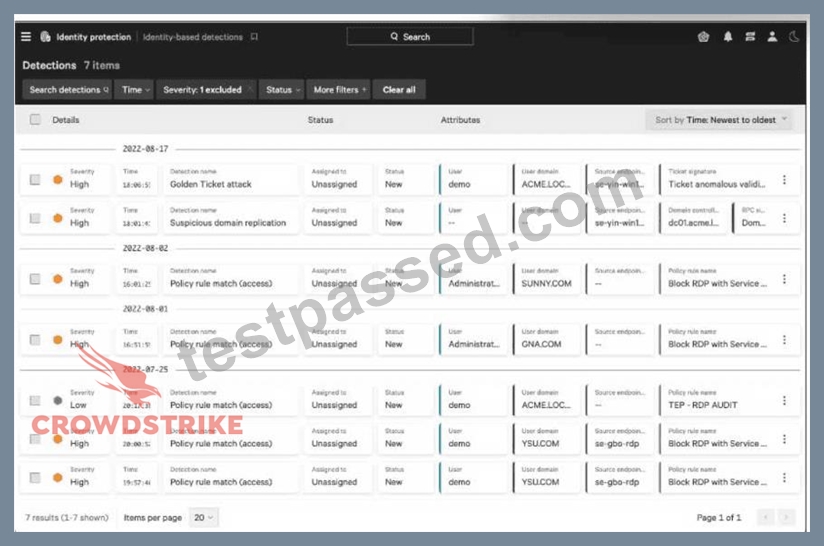
Which of the following are not included within the three-dot menu on Identity-based Detections?
- A. Edit status
- B. Add to Watchlist
- C. Add comment
- D. Add exclusion
Answer: B
Explanation:
In Falcon Identity Protection, thethree-dot (#) action menuon anidentity-based detectionprovides analysts with a limited set of actions that applydirectly to the detection itself. According to the CCIS curriculum, these actions are designed to support investigation workflow, tuning, and documentation.
The supported actions in the detection-level three-dot menu include:
* Edit status, which allows analysts to update the detection state (for example, New, In Progress, or Closed).
* Add comment, which enables collaboration and documentation directly on the detection.
* Add exclusion, where supported, to suppress future detections that match known benign behavior.
Add to Watchlistisnot includedin this menu because watchlists are applied toentities(such as users, service accounts, or endpoints), not to detections. Watchlists are managed from entity views or investigation workflows and are used to increase visibility and monitoring priority for specific identities-not to act on individual detections.
This distinction is emphasized in CCIS training to reinforce the separation betweenentity-centric actionsand detection-centric actions. Because watchlists operate at the entity level,Option Bis the correct and verified answer.
NEW QUESTION # 42
When an endpoint that has not been used in the last90 daysbecomes active, a detection forUse of Stale Endpointis reported.
- A. 60 days
- B. 180 days
- C. 30 days
- D. 90 days
Answer: D
Explanation:
Falcon Identity Protection identifiesstale endpointsas systems that have not authenticated or shown activity for an extended period and then suddenly become active. According to the CCIS curriculum, an endpoint that has been inactive for90 daysand then resumes activity will trigger aUse of Stale Endpointdetection.
This detection is important because attackers frequently exploit dormant or forgotten systems to re-enter environments, evade monitoring, or move laterally. A long period of inactivity followed by sudden authentication activity is considered a strong identity risk signal.
The 90-day threshold is used to establish a reliable inactivity baseline while minimizing false positives.
Shorter timeframes could incorrectly flag normal usage patterns, while longer timeframes could delay detection of genuine threats.
Because Falcon explicitly defines stale endpoint activity using a90-day inactivity window,Option Bis the correct answer.
NEW QUESTION # 43
Which of the following isNOTan available Goal within the Domain Security Overview?
- A. Privileged Users Management
- B. AD Hygiene
- C. Business Privileged Users Management
- D. Pen Testing
Answer: C
Explanation:
The Domain Security Overview in Falcon Identity Protection usesGoalsto frame identity risks into focused security assessment perspectives. These goals allow organizations to evaluate identity posture based on specific security priorities such as directory hygiene, privilege exposure, or overall attack surface reduction.
According to the CCIS curriculum, theavailable GoalsincludePrivileged Users Management,AD Hygiene, Pen Testing, andReduce Attack Surface. These goals are predefined by CrowdStrike and determine how risks are grouped, weighted, and presented in reports.
Business Privileged Users Managementisnot an available Goalwithin the Domain Security Overview.
While Falcon Identity Protection does support the concept ofbusiness privilegesand evaluates their impact on users and entities, this concept is handled through risk analysis and configuration-not as a selectable Domain Security Goal.
The CCIS documentation clearly distinguishes betweenGoals(which control reporting and assessment views) andbusiness privilege modeling(which influences risk scoring). Therefore,Option Bis the correct and verified answer.
NEW QUESTION # 44
The events are excluded by default while Low, Medium, and High detections are visible.
- A. Indiscrete
- B. Inferior
- C. Informational
- D. Internal
Answer: C
Explanation:
In Falcon Identity Protection,Informationaldetections represent low-impact events that provide context but do not indicate elevated identity risk. According to the CCIS curriculum,Informational events are excluded by defaultfrom standard detection views to reduce noise and allow analysts to focus on higher-risk activity.
By default,Low, Medium, and High severity detections remain visible, as these contribute directly to identity risk scoring, incident formation, and investigative workflows. Informational detections can still be viewed if filters are adjusted, but they are intentionally hidden in default views.
This design supports efficient threat triage by prioritizing detections that are more likely to represent real security concerns. The other options listed are not valid detection severity classifications within Falcon Identity Protection.
Because Informational events are excluded by default while higher-severity detections remain visible,Option Ais the correct and verified answer.
NEW QUESTION # 45
......
CrowdStrike IDP Exam Syllabus Topics:
| Topic | Details |
|---|---|
| Topic 1 |
|
| Topic 2 |
|
| Topic 3 |
|
| Topic 4 |
|
| Topic 5 |
|
| Topic 6 |
|
| Topic 7 |
|
| Topic 8 |
|
| Topic 9 |
|
| Topic 10 |
|
| Topic 11 |
|
Ace CrowdStrike IDP Certification with Actual Questions Jun 20, 2026 Updated: https://lead2pass.testpassed.com/IDP-pass-rate.html