Three versions of excellent products: PDF version, Soft version, APP version
We release three versions of HPE0-J82: HPE Storage Architect test questions materials. Different kinds of products satisfy different demands of people. If you like writing and reading on paper, PDF version of HPE0-J82 test questions are suitable for you. If you like studying on computer you can choose soft version or/and APP version.
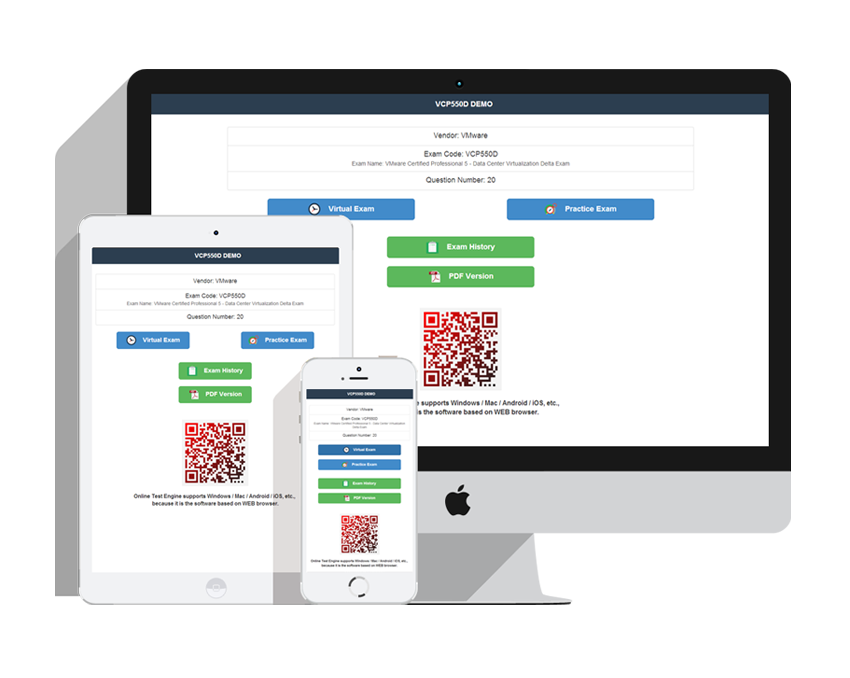
These two versions of HPE0-J82 test engine have some similar functions: timed test, mark your performance, point out wrong questions and remind you of practicing many times. Soft version of HPE0-J82: HPE Storage Architect test questions are downloaded and installed in personal computers (Windows operating system and Java environment). APP version of HPE0-J82 test questions are based on WEB browser, it supports Windows / Mac / Android / iOS etc.
Soft version of HPE0-J82: HPE Storage Architect test questions can be downloaded in more than 200 personal computers. Once you download software, you use it offline any time. If there is no network, you can copy on another computer. APP version of HPE0-J82 test questions are downloaded and installed well. It is based on web browser, if you do not close website, you can also use it offline. As to functional performance APP version of HP HPE0-J82 test exam materials may be much stabler than Soft version.
We guarantee that No Pass No Pay
We are confident about our HPE0-J82: HPE Storage Architect test questions materials that we can help users pass real test certainly. Our passing rate for HP HPE Storage Solutions exam is 99.69%. Most candidates will clear exam successfully. We make sure that if you fail exam sadly we will full refund to you unconditionally. If candidates send us your unqualified score scanned, we will refund to you directly. Please trust our HPE0-J82: HPE Storage Architect test questions. If you choose us, we will help you success surely.
After purchase, Instant Download: Upon successful payment, Our systems will automatically send the product you have purchased to your mailbox by email. (If not received within 12 hours, please contact us. Note: don't forget to check your spam.)
Golden service: 7/24 online service support
We support 7/24 online customer service even on large official holiday. No matter when candidates have any problem & advice about HPE0-J82: HPE Storage Architect test questions materials we are sure to reply and solve with you soon. Service staff performance assess criteria are required that any email and contact about HPE0-J82 test engine should be handled in two hours.
How can you get valid HPE0-J82: HPE Storage Architect test questions for passing exam? Many candidates are looking for valid test online to pass exam day to day. Here is your chance. Testpassed offers the best high passing rate HPE0-J82 test online to help candidates pass exam for sure. We are engaged in editing good test questions materials so many years. Our educational experts all have more than 8 years' experience in IT career certifications. Our HPE0-J82: HPE Storage Architect test questions are edited seriously and strictly. We guarantee our products help most of candidates pass test. If users pay much attention to our HP HPE0-J82 test questions most of users will get good passing score.

Golden service: one year service warrant after sale
If you purchase our HPE0-J82: HPE Storage Architect test questions materials, we guarantee our products are valid for one year. You can download our latest materials free of charge within one year if we release new HPE0-J82 test questions. If you are ready to purchase test engine, please rest assured that we will serve for ever user within one year before passing test.
HP HPE0-J82 Exam Syllabus Topics:
| Section | Objectives |
|---|---|
| Topic 1: Storage Management and Operations | - Storage provisioning and lifecycle management
|
| Topic 2: Data Protection and Availability | - Backup, replication, and disaster recovery
|
| Topic 3: HPE Storage Portfolio Overview | - HPE storage product families and positioning
|
| Topic 4: Storage Architecture and Design | - Core storage architecture concepts
|
| Topic 5: SAN and Connectivity Technologies | - Fibre Channel and iSCSI networking
|
HPE Storage Architect Sample Questions:
A Storage Administrator is evaluating a proposed lifecycle management policy for an object storage platform.
Configuration:
Versioning Enabled
Transition Non-Current Versions After 30 Days
Archive Non-Current Versions After 90 Days
Delete Non-Current Versions After 7 Years
Compliance Requirements:
Historical recovery capability
Long-term retention
Reduced storage cost
Which THREE outcomes should be expected? (Choose 3.)
- A. Capacity growth can be controlled through automated expiration policies
- B. Versioning prevents lifecycle policies from executing
- C. Archived versions are permanently inaccessible
- D. Lifecycle transitions can reduce storage costs for older object revisions
- E. Historical object versions remain recoverable until expiration policies are reached
A Capacity Planner is reviewing a GreenLake utilization report.
[Consumption Analytics]
Committed Capacity: 500 TB
Available Buffer Capacity: 120 TB
Current Physical Consumption: 465 TB
Growth Rate: 12 TB/month
Forecasted Buffer Utilization: 3 Months
Business Requirement:
"Avoid emergency procurement activities while maintaining uninterrupted growth." Which THREE observations are valid? (Choose 3.)
- A. Buffer capacity should remain unused because utilization indicates poor planning
- B. Consumption forecasting helps prevent service disruption caused by unexpected growth
- C. Buffer capacity is functioning as intended by absorbing growth prior to formal expansion activities
- D. Buffer capacity eliminates the need for future capacity reviews
- E. Expansion planning should begin before complete buffer consumption occurs
An HPE Pre-Sales Consultant is discussing disaster recovery strategies with a customer. The customer plans to rely entirely on native storage array snapshots (taken every 5 minutes) to protect a highly transactional Microsoft SQL Server database running on a bare-metal Windows server connected via Fibre Channel.
If the customer executes these storage array snapshots natively via the array's GUI without any host-level integration, what is the exact consistency state of the resulting snapshot, and what operational risk does this pose during a recovery?
- A. The snapshot is "Crash-Consistent"; the array captures the exact state of the disk blocks at that millisecond, completely ignoring data held in the Windows OS RAM or SQL buffers, risking database corruption and requiring a lengthy database log replay upon recovery
- B. The snapshot is "File-System-Consistent"; the array natively flushes the NTFS metadata tables before snapping the blocks, ensuring the OS boots perfectly but leaving the SQL application state unknown
- C. The snapshot is "Log-Consistent"; the array forces the SQL server to truncate its transaction logs to the snapshot delta file, preventing any data loss but corrupting the active database
- D. The snapshot is "Application-Consistent"; the array's ASICs automatically inspect the SQL payloads in flight to ensure zero transactions are dropped, guaranteeing instant recovery
An Infrastructure Capacity Planner is evaluating a legacy-to-modern storage migration assessment. The customer has a strict OpEx budget model, requires seamless scalability for an unpredictable VDI workload expansion, and mandates Proactive Support Manager integration.
They are deciding between acquiring HPE MSA Gen7 arrays via traditional CapEx or an HPE GreenLake for Block Storage solution.
Which THREE factors make the GreenLake consumption model the optimal choice for this specific assessment scenario? (Select all that apply.)
- A. It aligns perfectly with the customer's strict requirement for an OpEx-driven financial acquisition framework
- B. It eliminates the need to perform any pre-migration performance baselining on the legacy storage arrays
- C. It provides a lower total cost of ownership over a 10-year period compared to a fully depreciated CapEx model
- D. It allows for rapid, buffer-based capacity scaling to accommodate the unpredictable VDI workload growth
- E. It inherently includes advanced proactive support models, satisfying the Proactive Support Manager requirement
A Storage Architect is reviewing a proposed QoS design.
Array Sustainable Performance:
160,000 IOPS
Configured Minimum Guarantees:
Oracle RAC: 70,000
SAP HANA: 50,000
SQL Production: 45,000
VDI: 25,000
Which THREE conclusions are correct? (Choose 3.)
- A. The QoS design should be revised before implementation
- B. The configured guarantees exceed sustainable platform capability
- C. SLA violations may occur during periods of contention
- D. Thin provisioning compensates for oversubscribed performance guarantees
- E. The storage platform automatically creates additional performance resources during saturation events


 Valentina
 Riva
Riva 
 Novia
Novia  Larry
Larry  Lisa
Lisa  Zenobia
  Marvin
 Mamie
Mamie  Leonard
  Booth
Booth  Geoffrey
  Isidore
  Tabitha
  David
David  Lucien
  Natividad
  Enoch
Enoch  Zora
Zora  Sharon