How can you get valid PCED-30-02: PCED - Certified Entry-Level Data Analyst with Python test questions for passing exam? Many candidates are looking for valid test online to pass exam day to day. Here is your chance. Testpassed offers the best high passing rate PCED-30-02 test online to help candidates pass exam for sure. We are engaged in editing good test questions materials so many years. Our educational experts all have more than 8 years' experience in IT career certifications. Our PCED-30-02: PCED - Certified Entry-Level Data Analyst with Python test questions are edited seriously and strictly. We guarantee our products help most of candidates pass test. If users pay much attention to our Python Institute PCED-30-02 test questions most of users will get good passing score.

Three versions of excellent products: PDF version, Soft version, APP version
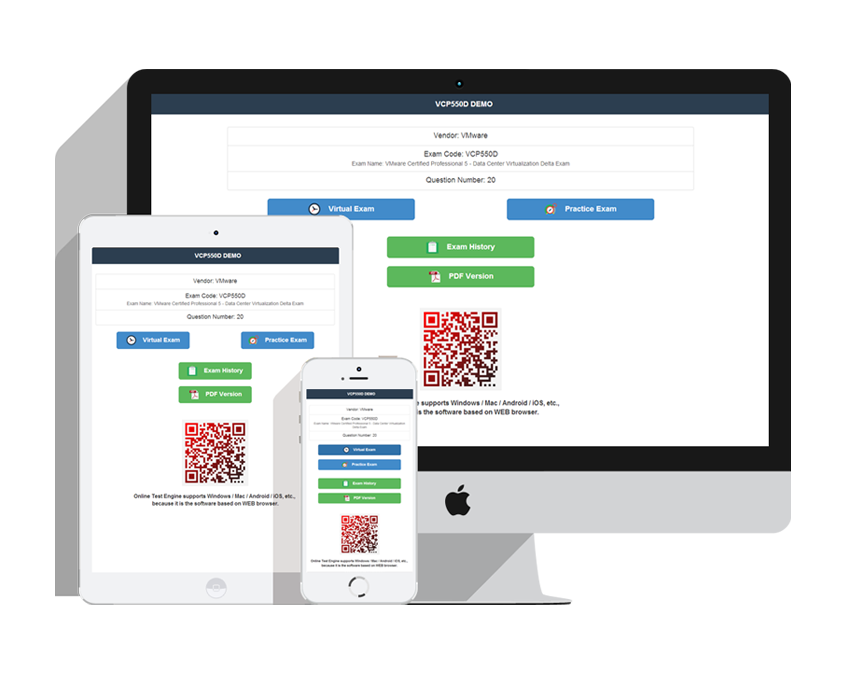
We release three versions of PCED-30-02: PCED - Certified Entry-Level Data Analyst with Python test questions materials. Different kinds of products satisfy different demands of people. If you like writing and reading on paper, PDF version of PCED-30-02 test questions are suitable for you. If you like studying on computer you can choose soft version or/and APP version.
These two versions of PCED-30-02 test engine have some similar functions: timed test, mark your performance, point out wrong questions and remind you of practicing many times. Soft version of PCED-30-02: PCED - Certified Entry-Level Data Analyst with Python test questions are downloaded and installed in personal computers (Windows operating system and Java environment). APP version of PCED-30-02 test questions are based on WEB browser, it supports Windows / Mac / Android / iOS etc.
Soft version of PCED-30-02: PCED - Certified Entry-Level Data Analyst with Python test questions can be downloaded in more than 200 personal computers. Once you download software, you use it offline any time. If there is no network, you can copy on another computer. APP version of PCED-30-02 test questions are downloaded and installed well. It is based on web browser, if you do not close website, you can also use it offline. As to functional performance APP version of Python Institute PCED-30-02 test exam materials may be much stabler than Soft version.
Golden service: one year service warrant after sale
If you purchase our PCED-30-02: PCED - Certified Entry-Level Data Analyst with Python test questions materials, we guarantee our products are valid for one year. You can download our latest materials free of charge within one year if we release new PCED-30-02 test questions. If you are ready to purchase test engine, please rest assured that we will serve for ever user within one year before passing test.
Golden service: 7/24 online service support
We support 7/24 online customer service even on large official holiday. No matter when candidates have any problem & advice about PCED-30-02: PCED - Certified Entry-Level Data Analyst with Python test questions materials we are sure to reply and solve with you soon. Service staff performance assess criteria are required that any email and contact about PCED-30-02 test engine should be handled in two hours.
We guarantee that No Pass No Pay
We are confident about our PCED-30-02: PCED - Certified Entry-Level Data Analyst with Python test questions materials that we can help users pass real test certainly. Our passing rate for Python Institute Python Institute PCED exam is 99.69%. Most candidates will clear exam successfully. We make sure that if you fail exam sadly we will full refund to you unconditionally. If candidates send us your unqualified score scanned, we will refund to you directly. Please trust our PCED-30-02: PCED - Certified Entry-Level Data Analyst with Python test questions. If you choose us, we will help you success surely.
After purchase, Instant Download: Upon successful payment, Our systems will automatically send the product you have purchased to your mailbox by email. (If not received within 12 hours, please contact us. Note: don't forget to check your spam.)
Python Institute PCED-30-02 Exam Syllabus Topics:
| Section | Objectives |
|---|---|
| Topic 1: Basic Statistics for Data Analysis | - Descriptive statistics
|
| Topic 2: Data Analysis and Visualization | - Data visualization
|
| Topic 3: Python Programming Fundamentals | - Basic syntax and data types
|
| Topic 4: Data Handling and Processing with Python | - Data manipulation libraries
|
Python Institute PCED - Certified Entry-Level Data Analyst with Python Sample Questions:
A Python loop uses range(5, 0, -2) to iterate backward. The programmer expects a decreasing sequence. Which values will actually be generated when this loop runs?
- A. 4, 2, 0
- B. 5, 4, 3, 2, 1
- C. 5, 3
- D. 5, 3, 1
Correct Answer: D 🗳️
Explanation: Only visible for TestPassed members. You can sign-up / login (it's free).
Below are six possible summaries for your presentation:
- Summary 1: "The data revealed a moderate positive correlation between age and recycling frequency. While 72% of students reported recycling paper regularly, only 39% reported recycling plastic."
- Summary 2: "Analysis showed notable differences in recycling habits by material type, with paper being most recycled and plastic least recycled."
- Summary 3: "Older kids recycled more than younger ones. Paper was the most recycled item- plastic got forgotten a lot."
- Summary 4: "Student responses showed positive environmental habits overall, though participation varied by waste type."
- Summary 5: "A lot of students said they recycle. Some didn't answer every question, so we couldn't figure out everything."
- Summary 6: "We asked more than 300 students about recycling. Most said they recycle paper, but way fewer recycle plastic." Which communication style is the best fit for Group A (data scientists) and Group B (12-year- olds), respectively? Select the best answer.
- A. Summary 1 for Group A, Summary 6 for Group B
- B. Summary 4 for Group A, Summary 3 for Group B
- C. Summary 2 for Group A. Summary 6 for Group B
- D. Summary 6 for Group A, Summary 3 for Group B
- E. Summary 6 for Group A, Summary 5 for Group B
- F. Summary 1 for Group A, Summary 3 for Group B
Correct Answer: F 🗳️
Explanation: Only visible for TestPassed members. You can sign-up / login (it's free).
Consider a Python program that assigns a string value "5" to a variable and then attempts to multiply it by an integer 3. The programmer expects numeric multiplication. What will actually happen when the code is executed?
- A. 8
- B. Error
- C. "555"
- D. 15
Correct Answer: C 🗳️
Explanation: Only visible for TestPassed members. You can sign-up / login (it's free).
You are given the following list of daily step counts:
steps = [8230, 9020, 7640, 8760, 10020, 2546, 9817]
Your task is to calculate:
- the standard deviation of the step counts,
- the average rounded up to the nearest whole number, and
- the median of the step counts.
Which code snippet correctly performs all three tasks? Select the best answer.
import statistics
- A. import math
print(statistics.stdev(steps))
print(math.ceil(statistics.mean(steps)))
print(statistics.median(steps)) - B. import math
print(math.stdev(steps))
print(statistics.mean(steps))
print(statistics.median(steps))
import statistics - C. import math
print(statistics.stdev(steps))
print(round(math.mean(steps)))
print(math.median(steps))
import statistics - D. import math
print(statistics.variance(steps))
print(math.ceil(sum(steps) / len(steps)))
print(math.floor(statistics.median(steps)))
import statistics
Correct Answer: A 🗳️
Explanation: Only visible for TestPassed members. You can sign-up / login (it's free).
You have collected sales data and want to compute the average using the NumPy library.
Which option correctly shows how to install NumPy and use it in your code to perform this task?
- A. To install NumPy:
pip install numpy as np
Then run this code:
import np
data = np.array([10, 20, 30])
print(np.mean(data)) - B. To install NumPy:
pip install numpy
Then run this code:
import numpy as np
data = numpy.arr([10, 20, 30])
print(numpy.mean(data)) - C. To install NumPy:
from pip install numpy
Then run this code:
import numpy as np
data = np.array([10, 20, 30])
print(np.mean(data))
Correct Answer: C 🗳️
Explanation: Only visible for TestPassed members. You can sign-up / login (it's free).
Viewing page 1 out of 11 pages.
Viewing questions 1-5 out of 52 questions.


 Horace

 Melissa
 Lucien

 Lawrence
 Juliet
 Amos

 Lawrence
 Borg
 Elizabeth
 Irma
 Kimberley
 Dinah
 Murray
 Dominic
 Aries
 Bevis
 Dana
 Baron
 Geoffrey
 Xavier
 Irma