


[2024] AZ-305 All-in-One Exam Guide Practice To your AZ-305 Exam!
Preparations of AZ-305 Exam 2024 Microsoft Azure Solutions Architect Expert Unlimited 292 Questions
Microsoft AZ-305 is an exam that is designed for professionals who are seeking to validate their expertise in designing Microsoft Azure infrastructure solutions. AZ-305 exam is intended for individuals who have an in-depth understanding of cloud computing technologies and architectures, as well as the ability to design, deploy, and manage solutions that leverage Azure services.
Achieving the Microsoft AZ-305 certification demonstrates a candidate’s expertise in designing Azure infrastructure solutions, and can help them advance their career in cloud computing. Designing Microsoft Azure Infrastructure Solutions certification is also a valuable asset for organizations that use Azure services, as it demonstrates that their employees have the skills and knowledge needed to design effective solutions that meet business requirements.
NEW QUESTION # 141
You have an Azure subscription named Sub1 that is linked to an Azure AD tenant named contoso.com.
You plan to implement two ASP.NET Core apps named App1 and App2 that will be deployed to 100 virtual machines in Sub1. Users will sign in to App1 and App2 by using their contoso.com credentials.
App1 requires read permissions to access the calendar of the signed-m user. App2 requires write permissions to access the calendar of the signed-in user.
You need to recommend an authentication and authorization solution for the apps. The solution must meet the following requirements:
* Use the principle of least privilege.
* Minimize administrative effort
What should you include in the recommendation? To answer, select the appropriate options in the answer area.
NOTE: Each correct selection is worth one pent.
Answer:
Explanation: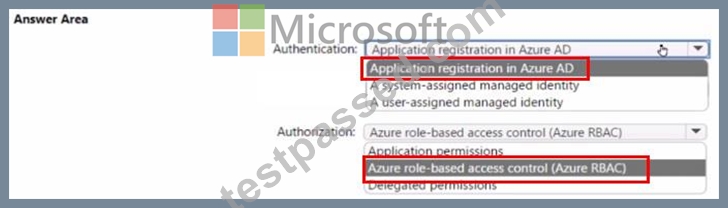
NEW QUESTION # 142
You have a resource group named RG1 that contains the objects shown in the following table.
You need to configure permissions so that App1 can copy all the secrets from KV1 to KV2. App1 currently has the Get permission for the secrets in KV1.
Which additional permissions should you assign to App1? To answer, select the appropriate options in the answer area.
NOTE: Each correct selection is worth one point.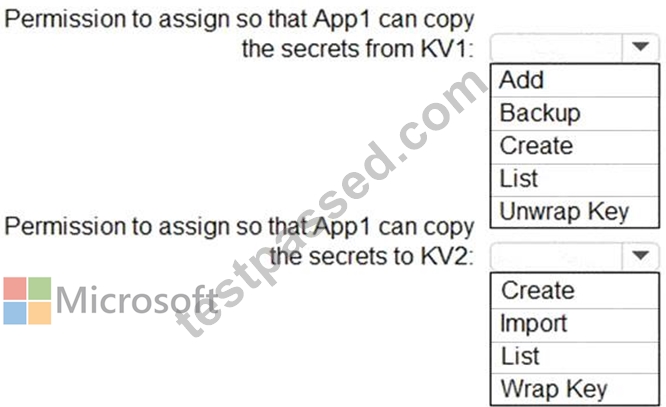
Answer:
Explanation: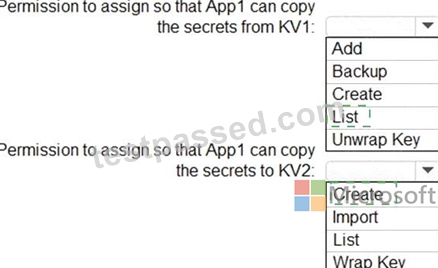
Explanation
Graphical user interface, text, application Description automatically generated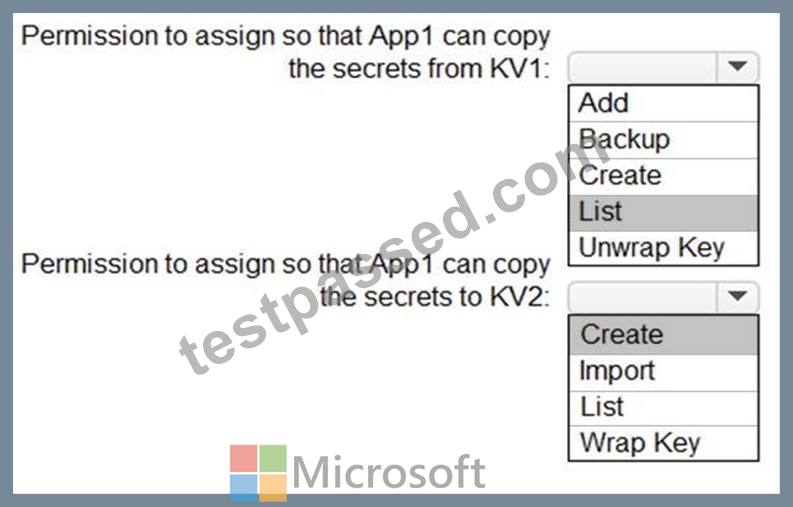
Box 1: List
Get: Gets the specified Azure key vault.
List: The List operation gets information about the vaults associated with the subscription.
Box 2: Create
Create Or Update: Create or update a key vault in the specified subscription.
Reference:
https://docs.microsoft.com/en-us/rest/api/keyvault/
NEW QUESTION # 143
Note: This question is part of a series of questions that present the same scenario. Each question in the series contains a unique solution that might meet the stated goals. Some question sets might have more than one correct solution, while others might not have a correct solution.
After you answer a question in this section, you will NOT be able to return to it. As a result, these questions will not appear in the review screen.
Your company has deployed several virtual machines (VMs) on-premises and to Azure. Azure ExpressRoute has been deployed and configured for on-premises to Azure connectivity.
Several VMs are exhibiting network connectivity issues.
You need to analyze the network traffic to determine whether packets are being allowed or denied to the VMs.
Solution: Use the Azure Traffic Analytics solution in Azure Log Analytics to analyze the network traffic.
Does the solution meet the goal?
- A. Yes
- B. No
Answer: B
Explanation:
Explanation
Instead use Azure Network Watcher to run IP flow verify to analyze the network traffic.
Reference:
https://docs.microsoft.com/en-us/azure/network-watcher/network-watcher-monitoring-overview
https://docs.microsoft.com/en-us/azure/network-watcher/network-watcher-ip-flow-verify-overview
NEW QUESTION # 144
You plan to use Azure SQL as a database platform.
You need to recommend an Azure SQL product and service tier that meets the following requirements:
* Automatically scales compute resources based on the workload demand
* Provides per second billing
What should you recommend? To answer, select the appropriate options in the answer area.
NOTE: Each correct selection is worth one point.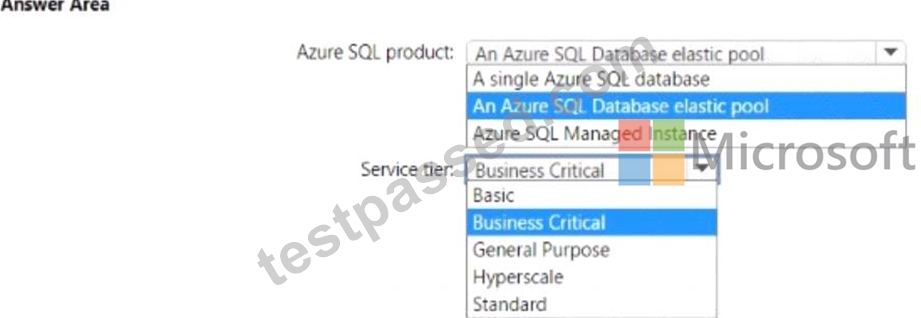
Answer:
Explanation: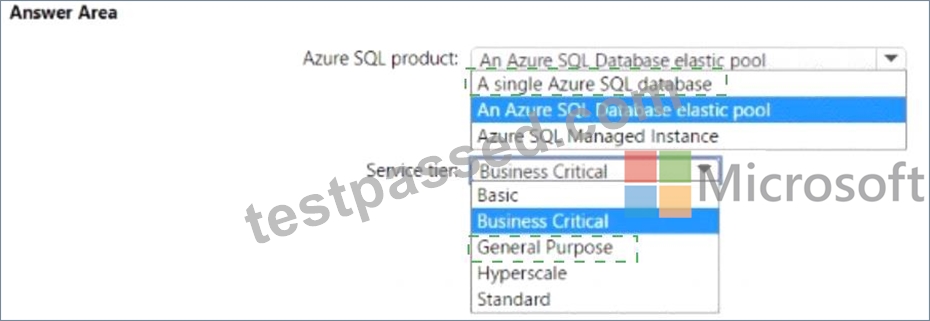
Explanation
A screenshot of a computer Description automatically generated
"Serverless is a compute tier for single databases in Azure SQL Database that automatically scales compute based on workload demand and bills for the amount of compute used per second. The serverless compute tier is available in the General Purpose service tier and currently in preview in the Hyperscale service tier."
https://learn.microsoft.com/en-us/azure/azure-sql/database/serverless-tier-overview
NEW QUESTION # 145
You have an on-premises Microsoft SQL Server database named SQL1.
You plan to migrate SQL 1 to Azure.
You need to recommend a hosting solution for SQL1. The solution must meet the following requirements:
* Support the deployment of multiple secondary, read-only replicas.
* Support automatic replication between primary and secondary replicas.
* Support failover between primary and secondary replicas within a 15-minute recovery time objective (RTO).
Answer:
Explanation:
NEW QUESTION # 146
You have the resources shown in the following table.
CDB1 hosts a container that stores continuously updated operational data.
You are designing a solution that will use ASI to analyze the operational data daily.
You need to recommend a solution to analyze the data without affecting the performance of the operational data store.
What should you include in the recommendation?
- A. Azure Synapse Analytics with PolyBase data loading
- B. Azure Synapse Link for Azure Cosmos DB
- C. Azure Data Factory with Azure Cosmos DB and Azure Synapse Analytics connectors
- D. Azure Cosmos DB change feed
Answer: B
NEW QUESTION # 147
You have an on-premises database that you plan to migrate to Azure.
You need to design the database architecture to meet the following requirements:
Support scaling up and down.
Support geo-redundant backups.
Support a database of up to 75 TB.
Be optimized for online transaction processing (OLTP).
What should you include in the design? To answer, select the appropriate options in the answer area.
NOTE: Each correct selection is worth one point.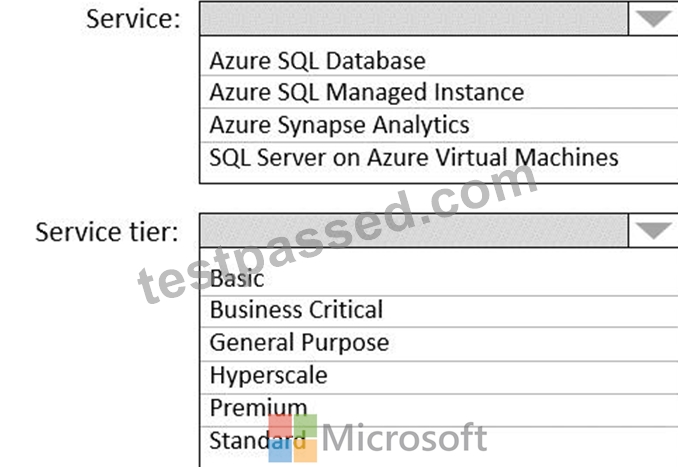
Answer:
Explanation:
Reference:
https://docs.microsoft.com/en-us/azure/azure-sql/database/active-geo-replication-overview
https://medium.com/awesome-azure/azure-difference-between-azure-sql-database-and-sql-server-on-vm-comparison-azure-sql-vs-sql-server-vm-cf02578a1188
NEW QUESTION # 148
You have an Azure Active Directory (Azure AD) tenant.
You plan to use Azure Monitor to monitor user sign-ins and generate alerts based on specific user sign-in events.
You need to recommend a solution to trigger the alerts based on the events.
What should you include in the recommendation? To answer, select the appropriate options in the answer area.
NOTE: Each correct selection is worth one point.
Answer:
Explanation:
Reference:
https://4sysops.com/archives/how-to-create-an-azure-ad-admin-login-alert/
https://docs.microsoft.com/en-us/azure/azure-monitor/platform/alerts-log
NEW QUESTION # 149
You plan to deploy Azure Databricks to support a machine learning application. Data engineers will mount an Azure Data Lake Storage account to the Databricks file system. Permissions to folders are granted directly to the data engineers.
You need to recommend a design for the planned Databrick deployment. The solution must meet the following requirements:
Ensure that the data engineers can only access folders to which they have permissions.
Minimize development effort.
Minimize costs.
What should you include in the recommendation? To answer, select the appropriate options in the answer area.
NOTE: Each correct selection is worth one point.
Answer:
Explanation: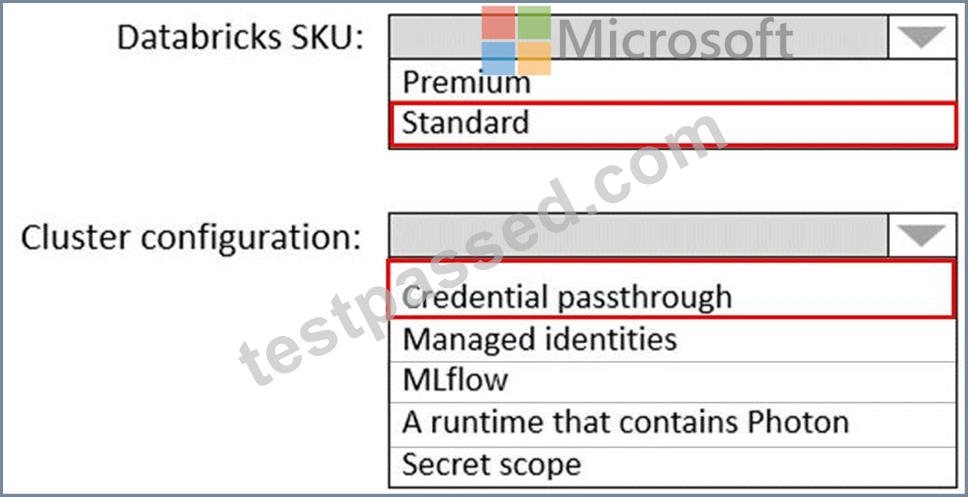
Reference:
https://docs.microsoft.com/en-us/azure/databricks/security/credential-passthrough/adls-passthrough
NEW QUESTION # 150
Your company has two on-premises sites in New York and Los Angeles and Azure virtual networks in the East US Azure region and the West US Azure region. Each on-premises site has Azure ExpressRoute circuits to both regions.
You need to recommend a solution that meets the following requirements:
* Outbound traffic to the Internet from workloads hosted on the virtual networks must be routed through the closest available on-premises site.
* If an on-premises site fails, traffic from the workloads on the virtual networks to the Internet must reroute automatically to the other site.
What should you include in the recommendation? To answer, select the appropriate options in the answer area.
NOTE: Each correct selection is worth one point.
Answer:
Explanation:
Explanation
Graphical user interface, text, application, email Description automatically generated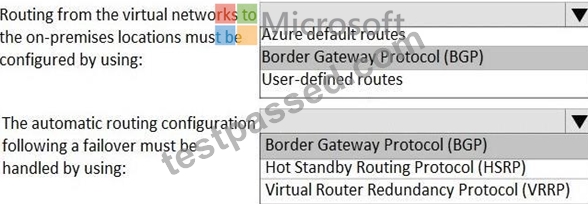
An on-premises network gateway can exchange routes with an Azure virtual network gateway using the border gateway protocol (BGP). Using BGP with an Azure virtual network gateway is dependent on the type you selected when you created the gateway. If the type you selected were: ExpressRoute: You must use BGP to advertise on-premises routes to the Microsoft Edge router. You cannot create user-defined routes to force traffic to the ExpressRoute virtual network gateway if you deploy a virtual network gateway deployed as type:
ExpressRoute. You can use user-defined routes for forcing traffic from the Express Route to, for example, a Network Virtual Appliance.
https://docs.microsoft.com/ja-jp/azure/expressroute/designing-for-disaster-recovery-with-expressroute-privatepee
https://docs.microsoft.com/en-us/azure/expressroute/expressroute-optimize-routing#suboptimal-routing-from-cus
NEW QUESTION # 151
Your company deploys several Linux and Windows virtual machines (VMs) to Azure. The VMs are deployed with the Microsoft Dependency Agent and the Log Analytics Agent installed by using Azure VM extensions. On-premises connectivity has been enabled by using Azure ExpressRoute.
You need to design a solution to monitor the VMs.
Which Azure monitoring services should you use? To answer, select the appropriate Azure monitoring services in the answer area.
NOTE: Each correct selection is worth one point.
Answer:
Explanation: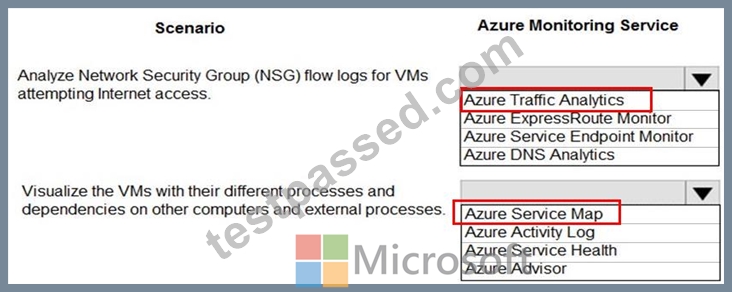
Reference:
https://docs.microsoft.com/en-us/azure/network-watcher/traffic-analytics
https://docs.microsoft.com/en-us/azure/azure-monitor/insights/service-map
NEW QUESTION # 152
You have two on-premises Microsoft SQL Server 2017 instances that host an Always On availability group named AG1. AG1 contains a single database named DB1.
You have an Azure subscription that contains a virtual machine named VM1VM1 runs Linux and contains a SQL Server 2019 instance.
You need to migrate DB1 to VMI. The solution must minimize downtime on DBI. What should you do? To answer, select the appropriate options in the answer area.
NOTE: Each correct selection is worth one point.
Answer:
Explanation:
Explanation
NEW QUESTION # 153
You have an Azure subscription. The subscription contains Azure virtual machines that run Windows Server 2016 and Linux.
You need to use Azure Log Analytics design an alerting strategy for security-related events.
Which Log Analytics tables should you query? To answer, drag the appropriate tables to the correct log types. Each value may be used once, more than once, or not at all. You may need to drag the split bar between panes or scroll to view content.
NOTE: Each correct selection is worth one point.
Answer:
Explanation: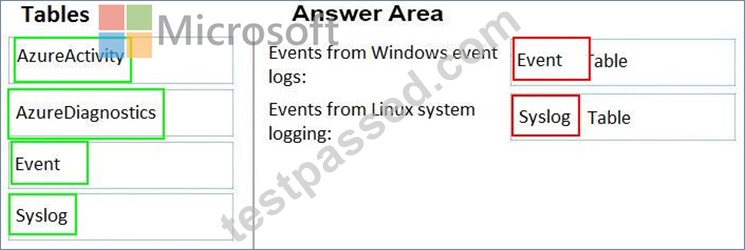
https://docs.microsoft.com/en-us/azure/azure-monitor/platform/log-analytics-agent Windows Event logs --> Information sent to the Windows event logging system. Syslog --> Information sent to the Linux event logging system.
NEW QUESTION # 154
You need to recommend a solution that meets the data requirements for App1.
What should you recommend deploying to each availability zone that contains an instance of App1?
- A. an Azure SQL database that uses active geo-replication
- B. an Azure Storage account that uses geo-zone-redundant storage (GZRS)
- C. an Azure Data Lake store that uses geo-zone-redundant storage (GZRS)
- D. an Azure Cosmos DB that uses multi-region writes
Answer: D
Explanation:
Topic 4, HABInsurance
Current environment
General
An insurance company, HABInsurance, operates in three states and provides home, auto, and boat insurance. Besides the head office, HABInsurance has three regional offices.
Technology assessment
The company has two Active Directory forests: main.habinsurance.com and region.habinsurance.com. HABInsurance's primary internal system is Insurance Processing System (IPS). It is an ASP.Net/C# application running on IIS/Windows Servers hosted in a data center. IPS has three tiers: web, business logic API, and a datastore on a back end. The company uses Microsoft SQL Server and MongoDB for the backend. The system has two parts: Customer data and Insurance forms and documents. Customer data is stored in Microsoft SQL Server and Insurance forms and documents - in MongoDB. The company also has 10 TB of Human Resources (HR) data stored on NAS at the head office location. Requirements General HABInsurance plans to migrate its workloads to Azure. They purchased an Azure subscription. Changes During a transition period, HABInsurance wants to create a hybrid identity model along with a Microsoft Office 365 deployment. The company intends to sync its AD forests to Azure AD and benefit from Azure AD administrative units functionality.
HABInsurance needs to migrate the current IPSCustomers SQL database to a new fully managed SQL database in Azure that would be budget-oriented, balanced with scalable compute and storage options. The management team expects the Azure database service to scale the database resources dynamically with minimal downtime. The technical team proposes implementing a DTU-based purchasing model for the new database.
HABInsurance wants to migrate Insurance forms and documents to Azure database service. HABInsurance plans to move IPS first two tiers to Azure without any modifications. The technology team discusses the possibility of running IPS tiers on a set of virtual machines instances. The number of instances should be adjusted automatically based on the CPU utilization. An SLA of 99.95% must be guaranteed for the compute infrastructure.
The company needs to move HR data to Azure File shares.
In their new Azure ecosystem, HABInsurance plans to use internal and third-party applications. The company considers adding user consent for data access to the registered applications Later, the technology team contemplates adding a customer self-service portal to IPS and deploying a new IPS to multi-region ASK. But the management team is worried about performance and availability of the multi-region AKS deployments during regional outages.
NEW QUESTION # 155
You need to implement the Azure RBAC role assignment. The solution must meet the authentication and authorization requirements.
How many assignment should you configure for the Network Contributor role for Role1? To answer, select appropriate in the answer area.
NOTE: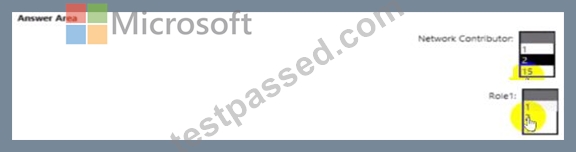
Answer:
Explanation:
NEW QUESTION # 156
You have an Azure subscription that contains the resources shown in the following table.
You create an Azure SQL database named DB1 that is hosted in the East US region.
To DB1, you add a diagnostic setting named Settings1. Settings1 archives SQLInsights to storage1 and sends SQLInsights to Workspace1.
For each of the following statements, select Yes if the statement is true. Otherwise, select No.
NOTE: Each correct selections is worth one point.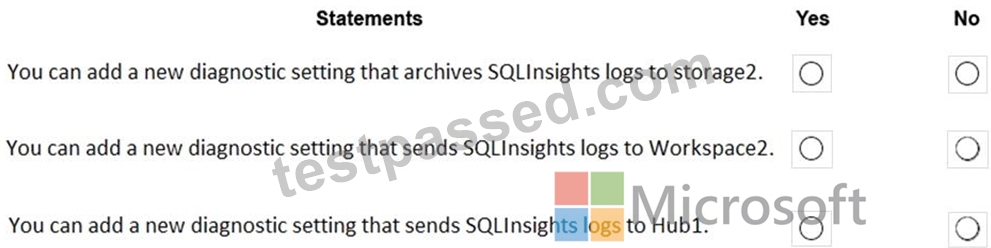
Answer:
Explanation:
NEW QUESTION # 157
You have a resource group named RG1 that contains the objects shown in the following table.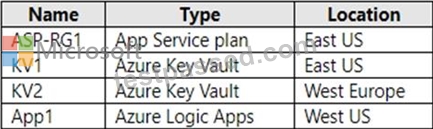
You need to configure permissions so that App1 can copy all the secrets from KV1 to KV2. App1 currently has the Get permission for the secrets in KV1.
Which additional permissions should you assign to App1? To answer, select the appropriate options in the answer area.
NOTE: Each correct selection is worth one point.
Answer:
Explanation: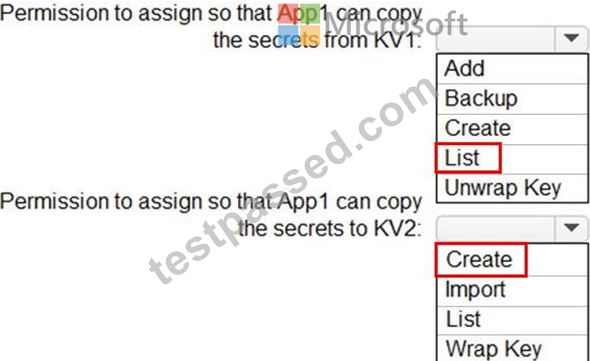
Reference:
https://docs.microsoft.com/en-us/rest/api/keyvault/
NEW QUESTION # 158
Your company deploys an Azure App Service Web App.
During testing the application fails under load. The application cannot handle more than 100 concurrent user sessions. You enable the Always On feature. You also configure auto-scaling to increase counts from two to
10 based on HTTP queue length.
You need to improve the performance of the application.
Which solution should you use for each application scenario? To answer, select the appropriate options in the answer area.
NOTE: Each correct selection is worth one point.
Answer:
Explanation: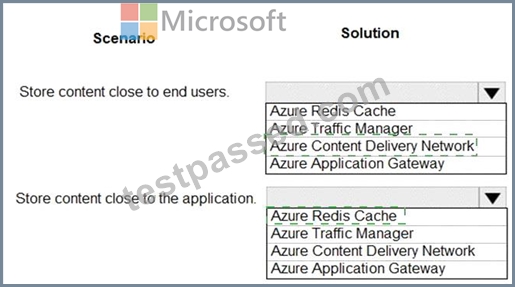
Explanation
Graphical user interface, text Description automatically generated with medium confidence
Box 1: Content Delivery Network
A content delivery network (CDN) is a distributed network of servers that can efficiently deliver web content to users. CDNs store cached content on edge servers in point-of-presence (POP) locations that are close to end users, to minimize latency.
Azure Content Delivery Network (CDN) offers developers a global solution for rapidly delivering high-bandwidth content to users by caching their content at strategically placed physical nodes across the world. Azure CDN can also accelerate dynamic content, which cannot be cached, by leveraging various network optimizations using CDN POPs. For example, route optimization to bypass Border Gateway Protocol (BGP).
Box 2: Azure Redis Cache
Azure Cache for Redis is based on the popular software Redis. It is typically used as a cache to improve the performance and scalability of systems that rely heavily on backend data-stores. Performance is improved by temporarily copying frequently accessed data to fast storage located close to the application. With Azure Cache for Redis, this fast storage is located in-memory with Azure Cache for Redis instead of being loaded from disk by a database.
References:
https://docs.microsoft.com/en-us/azure/azure-cache-for-redis/cache-overview
NEW QUESTION # 159
You deploy several Azure SQL Database instances.
You plan to configure the Diagnostics settings on the databases as shown in the following exhibit.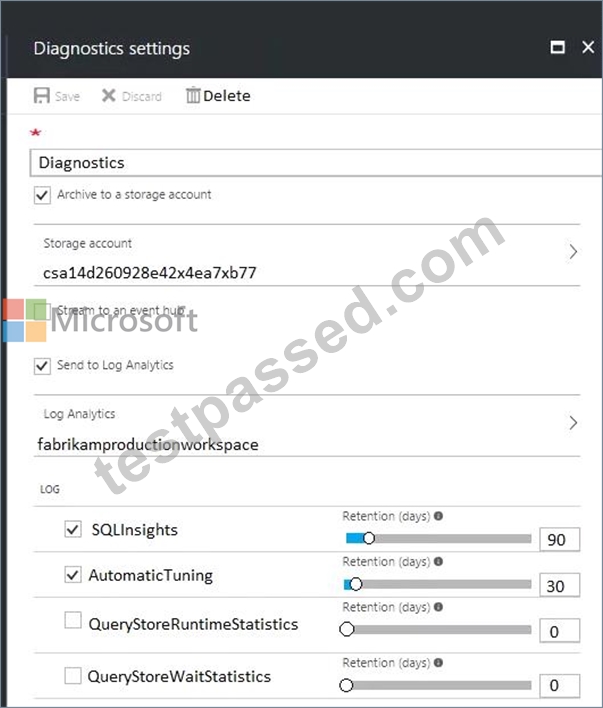
Use the drop-down menus to select the answer choice that completes each statement based on the information presented in the graphic.
NOTE: Each correct selection is worth one point.
Answer:
Explanation:
NEW QUESTION # 160
You have an Azure subscription.
Your on-premises network contains a file server named Server1. Server 1 stores 5 TB of company files that are accessed rarely.
You plan to copy the files to Azure Storage.
You need to implement a storage solution for the files that meets the following requirements:
* The files must be available within 24 hours of being requested.
* Storage costs must be minimized.
Which two possible storage solutions achieve this goal? Each correct answer presents a complete solution. NOTE: Each correct selection is worth one point.
- A. Create a general-purpose v2 storage account that is configured for the Cool default access tier. Create a file share in the storage account and copy the files to the file share.
- B. Create a general-purpose v1 storage account. Create a blob container and copy the files to the blob container.
- C. Create a general-purpose v2 storage account that is configured for the Hot default access tier. Create a blob container, copy the files to the blob container, and set each file to the Archive access tier.
- D. Create an Azure Blob storage account that is configured for the Cool default access tier. Create a blob container, copy the files to the blob container, and set each file to the Archive access tier.
- E. Create a general-purpose v1 storage account. Create a file share in the storage account and copy the files to the file share.
Answer: C,D
Explanation:
https://docs.microsoft.com/en-us/azure/storage/blobs/manage-access-tier?tabs=portal
NEW QUESTION # 161
The application will host video files that range from 50 MB to 12 GB. The application will use certificate-based authentication and will be available to users on the internet.
You need to recommend a storage option for the video files. The solution must provide the fastest read performance and must minimize storage costs.
What should you recommend?
- A. Azure Files
- B. Azure Blob Storage
- C. Azure Data Lake Storage Gen2
- D. Azure SQL Database
Answer: B
Explanation:
Explanation
Blob Storage: Stores large amounts of unstructured data, such as text or binary data, that can be accessed from anywhere in the world via HTTP or HTTPS. You can use Blob storage to expose data publicly to the world, or to store application data privately.
Max file in Blob Storage. 4.77 TB.
Reference:
https://docs.microsoft.com/en-us/azure/architecture/solution-ideas/articles/digital-media-video
NEW QUESTION # 162
......
Focus on AZ-305 All-in-One Exam Guide For Quick Preparation: https://lead2pass.testpassed.com/AZ-305-pass-rate.html