


Brilliant 201 Exam Dumps Get 201 Dumps PDF
201 Dumps PDF - 201 Real Exam Questions Answers
Understanding of functional and technical aspects of Troubleshooting basic device management connectivity issues
The following will be discussed in this section:
- Determine whether a filter is enabled
- Interpret a packet filter rule list in a given situation
- Check and interpret port lockdown settings and packet filters in order to determine the cause of a management connectivity issue to a Self-IP
- Apply connectivity troubleshooting tools (i.e. ping, traceroute, http/https availability, remote shell access, network based console access) in the appropriate situation
- Isolate potential causes of basic network connectivity issues, given scenarios related to: client configuration, client network access, device network access, network topologies
Who should take the F5-201: TMOS Administration Exam
People who are interested in getting a F5 Professional Certification which validates your expertise in manipulating the entire application stack - from traditional network knowledge all the way to advanced application-layer understanding, with the ability to integrate those two worlds. Candidates should have a basic understanding of network fundamentals, protocols, and common traffic management concepts. The student should also understand the basic concepts of F5 technology as applied to network fundamentals, protocols, and traffic management.
Candidates should have the following knowledge/capabilities:
- Describe valid uses/methods of HTTP.
- Explain the seven layers of the Open Systems Interconnection (OSI) model.
- Articulate the advantages of a full application proxy.
- Identify and define the components of TMOS (F5 Traffic Management Operating System).
NEW QUESTION 60
Which parameters are set to the same value when a pair of BIGElIP devices are synchronized.
- A. profile definitions
- B. MAC masquerade addresses
- C. system clocks
- D. host names
- E. VLAN failElsafe settings
Answer: A
NEW QUESTION 61
The incoming client IP address is 195.64.45.52 and the last five connections have been sent to members A, C, E, D and B.
The incoming client IP address is 195.64.45.52 and the last five connections have been sent to members A, C, E, D and B.
Given the virtual server, pool, and persistence definitions and statistics shown in the above graphic, which member will be used for the next connection.
- A. 10.10.20.3:8010.10.20.3:80
- B. 10.10.20.2:8010.10.20.2:80
- C. 10.10.20.4:8010.10.20.4:80
- D. 10.10.20.5:8010.10.20.5:80
- E. 10.10.20.1:80
- F. It cannot be determined with the information given.
Answer: A
NEW QUESTION 62
Refer to the exhibit.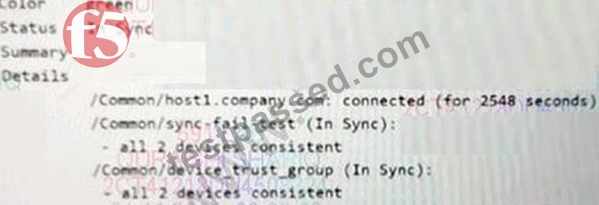
Which TMSH command generated this output?
- A. tmsh list /sys sync-status
- B. tmsh show /cm sync status
- C. tmsh show /sys sync-status
- D. tmsh list /cm sync-status
Answer: B
NEW QUESTION 63
A virtual server is configured to offload SSL from a pool of backend servers. When users connect to the virtual server, they successfully establish an SSL connection but no content is displayed. A packet trace performed on the server shows that the server receives and responds to the request. What should a BIG-IP Administrator do to resolve the problem?
- A. disable SNAT
- B. enable Server SSL profile
- C. disable Server SSL profile
- D. enable SNAT
Answer: C
NEW QUESTION 64
All pool members are online. All other virtual server settings are at default What might after the load balancing behavior?
- A. adding a persistence profile
- B. enabing a falback host in the http profile
- C. enabing SNAT automap
- D. adding a oneconnect profile
Answer: A
NEW QUESTION 65
A BIGJP Administrator needs to load a UCS file but must exclude the license file. How should the administrator perform this task?
- A. From the CLI with command(tmos) tmsh load /sys ucs <ucs filename> no-license
- B. From the GUI, select the UCS file, unchcck the license box, and click restore
- C. From the GUI, select the UCS file and click restore
- D. From the CLI with command U tmsh load /$ys ucs <ucs filename> no-license
Answer: D
NEW QUESTION 66
A BIG-IP Administrator is creating a new Trunk on the BIG-IP device. What objects should be added to the new Trunk being created?
- A. Network routes
- B. VLANS
- C. IP addresses
- D. Interfaces
Answer: D
Explanation:
trunk is a portchannel, you need to add a physical interface.
NEW QUESTION 67
Monitors can be assigned to which three resources. (Choose three.)
- A. virtual servers
- B. nodes
- C. iRules
- D. NATs
- E. SNATs
- F. pool members
- G. pools
Answer: B,F,G
NEW QUESTION 68
What is the purpose of MAC masquerading.
- A. to minimize connection loss due to ARP cache refresh delays
- B. to prevent ARP cache errors
- C. to allow both BIGElIP devices to simultaneously use the same MAC address
- D. to minimize ARP entries on routers
Answer: A
NEW QUESTION 69
A virtual server is listening at 10.10.1.100:80 and has the following
iRule associated with it: when HTTP_REQUEST { if {[HTTP::uri] ends_with "txt" } { pool pool1 } elseif {[HTTP::uri] ends_with "php" } { pool pool2 } If a user connects to http://10.10.1.100/foo.html, which pool will receive the request.
- A. pool1
- B. Unknown. The pool cannot be determined from the information provided.
- C. pool2
- D. None. The request will be dropped.
Answer: B
NEW QUESTION 70
A BIG-IP Administrator has configured a BIG-IP cluster with remote user authentication against dcOl f5trn.com. Only local users can successfully log into the system. Configsync is also failing.
Which two tools should the 8IG-IP Administrator use to further investigate these issues? (Choose two)
- A. dig
- B. ntpq
- C. pam_timestamp_check
- D. passwd
- E. pwck
Answer: B,D
NEW QUESTION 71
A user wants to use the iHealth Upgrade Advisor to determine any issues with upgrading TMOS from 13.0 to 13.1.
Where can the user generate the QKView to upload to iHealth?
- A. System > Archives
- B. System > Configuration
- C. System > Software Management
- D. System > Support
Answer: D
NEW QUESTION 72
A BIG-IP Administrator adds new Pool Members into an existing, highly utilized pool. Soon after, there are reports that the application is failing to load for some users. What pool level setting should the BIG-IP Administrator check?
- A. Availability Requirement
- B. Slow Ramp Time
- C. Allow SNAT
- D. Action On Service Down
Answer: B
Explanation:
Explanation
Option ABC is a global configuration, has nothing to do with the new pool member, select D after excluding
NEW QUESTION 73
Which cookie persistence method requires the fewest configuration changes on the web servers to be implemented correctly.
- A. session
- B. rewrite
- C. insert
- D. passive
Answer: C
NEW QUESTION 74
The BIG-IP Administrator needs to perform a BIG-IP device upgrade to the latest version of TMOS. Where can the administrator obtain F5 documentation on upgrade requirements?
- A. Network > Interfaces
- B. iHealth
- C. Local Traffic > Virtual Servers
- D. AsKFS
- E. Local Traffic > Pools
Answer: E
NEW QUESTION 75
Refer to the exhibit.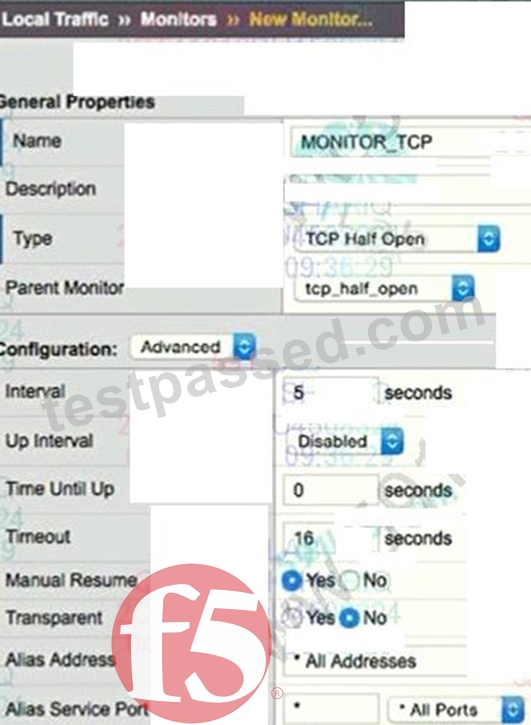
A pool member fails the monitor checks for about 30 minutes and then starts passing the monitor checks. New traffic is Not being sent to the pool member.
What is the likely reason for this problem?
- A. Time Until Up is zero
- B. The pool member is disabled
- C. Manual resume is enabled
- D. Monitor Type is TCP Half Open
Answer: C
NEW QUESTION 76
Refer to the exhibit.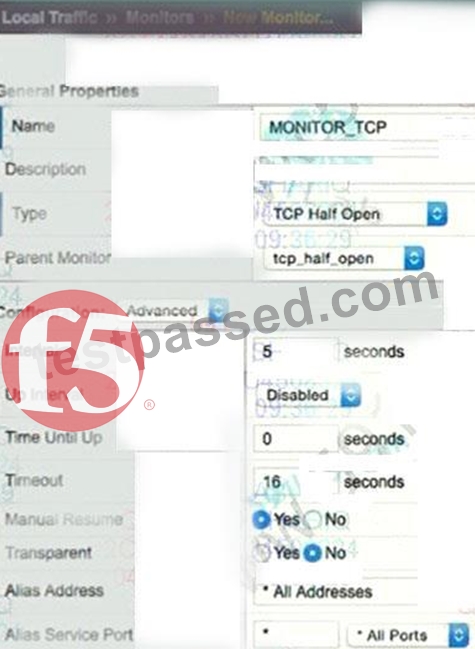
A pool member fails the monitor checks for about 30 minutes and then starts passing the monitor checks. New traffic is Not being sent to the pool member.
What is the likely reason for this problem?
- A. Time Until Up is zero
- B. The pool member is disabled
- C. Manual resume is enabled
- D. Monitor Type is TCP Half Open
Answer: C
NEW QUESTION 77
Refer to the exhibit.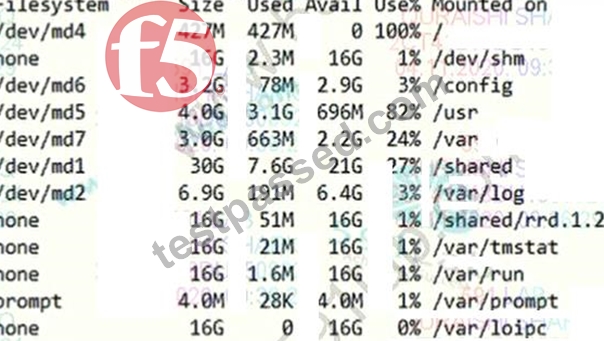
The BIG-IP Administrator is investigating disk utilization on the BIG-IP device.
What should the BIG-IP Administrator check next?
- A. Large files on the / file system
- B. Results from the EUD test
- C. Results from the platform diagnostics test
- D. Large files on /usr file system
Answer: A
NEW QUESTION 78
A pool of four servers has been partially upgraded for two new servers with more memory and CPU capacity.
The BIG-IP Administrator must change the load balance method to consider more connections for the two new servers. Which load balancing method considers pool member CPU and memory load?
- A. Ratio
- B. Round Robin
- C. Least Connection
- D. Dynamic Ratio
Answer: A
NEW QUESTION 79
A BIG-IP Administrator makes a configuration change to a Virtual Server on the Standby device of an HA pair. The HA pair is currently configured with Auto-Sync Enabled. What effect will the change have on the HA pair configuration?
- A. The change will take effect when Auto-Sync propagates the config to the HA pair.
- B. The change will be undone next time a configuration change is made on the Active device.
- C. The change will be undone when Auto-Sync propagates the config to the HA pair.
- D. The change will be propagated next time a configuration change is made on the Active device.
Answer: A
NEW QUESTION 80
Assume a virtual server is configured with a ClientSSL profile. What would the result be if the virtual server's destination port were not 443?
- A. Since the virtual server is associated with a ClientSSL profile, it will always process traffic sent to port 443.
- B. SSL termination could not be performed if the virtual server's port was not port 443.
- C. As long as client traffic was directed to the alternate port, the virtual server would work as intended.
- D. Virtual servers with a ClientSSL profile are always configured with a destination port of 443.
Answer: C
NEW QUESTION 81
A Standard Virtual Server for a web application is configured with Automap for the Source Address Translation option. The original source address of the client must be known by the backend servers. What should the BIG-IP Administrator configure to meet this requirement?
- A. The Virtual Server type as Performance (HTTP)
- B. An HTTP Transparent profile
- C. A SNAT Pool with the client IP
- D. An HTTP profile to insert the X-Forward-For header
Answer: D
Explanation:
Explanation
Because it is a web application, you can insert the source IP in the xff field in the http profile.
NEW QUESTION 82
You have a pool of servers that need to be tested. All of the servers but one should be tested every 10 seconds, but one is slower and should only be tested every 20 seconds. How do you proceed?
- A. It can be done, but will require assigning monitors to each pool member.
- B. It cannot be done. All of the members of a pool must be tested at the same frequency.
- C. It can be done by assigning one monitor to the pool and a different monitor to the slower pool member.
- D. It cannot be done. All monitors test every five seconds.
Answer: C
NEW QUESTION 83
Which statement describes a typical purpose of iRules?
- A. iRules can be used to look at client requests and server responses to choose a pool member to select for load balancing
- B. iRules can be used to update the timers on monitors as a server load changes.
- C. iRules can be used to add individual control characters to an HTTP data stream.
- D. iRules can examine a server response and remove it from a pool if the response is unexpected.
Answer: C
NEW QUESTION 84
......
Valid 201 Test Answers & F5 201 Exam PDF: https://lead2pass.testpassed.com/201-pass-rate.html