


Updated Mar-2025 Test Engine to Practice D-PE-OE-23 Test Questions
D-PE-OE-23 Real Exam Questions Test Engine Dumps Training With 52 Questions
NEW QUESTION # 30
What is the default IP Address for the iDRAC?
- A. 192.168.1.120
- B. 10.1.1.1
- C. 192.168.0.120
- D. 10.1.2.1
Answer: C
Explanation:
Server Management and Configuration Tools (14%)
* Define the function of the iDRAC, login procedures, licensing, and connection methods What is iDRAC?
The Integrated Dell Remote Access Controller (iDRAC) is a management solution built into Dell PowerEdge servers. It provides comprehensive, remote management capabilities, including system monitoring, configuration, and maintenance.
Default IP Address for iDRAC:
* The default IPv4 IP address for iDRAC is:192.168.0.120
* Subnet Mask:255.255.255.0
* Default Gateway:Not set by default
Explanation of Options:
* Option A: 192.168.1.120
* Incorrect: This IP address is not the default for iDRAC.
* Option B: 10.1.2.1
* Incorrect: Not associated with iDRAC's default settings.
* Option C: 10.1.1.1
* Incorrect: Also not the default iDRAC IP address.
* Option D: 192.168.0.120
* Correct: This is the default IP address assigned to iDRAC interfaces.
Accessing iDRAC Using the Default IP:
* Network Configuration:
* Ensure your management station (laptop/PC) is configured with an IP address in the192.168.0.x subnet, excluding192.168.0.120.
* Connecting to iDRAC:
* Open a web browser and navigate tohttps://192.168.0.120
* Accept any security warnings related to self-signed certificates.
* Default Credentials:
* Username:root
* Password:calvin
* Note: For security reasons, newer servers may require you to set a unique password upon initial setup.
Dell Operate References:
* Server Management and Configuration Tools (14%)
* Define the function of the iDRAC, login procedures, licensing, and connection methods:
Knowing the default IP address is essential for initial access and configuration of the iDRAC.
* System Administration (18%)
* Verify health status and iDRAC license: Initial access to the iDRAC is necessary to verify system health and configure licensing options.
Conclusion:
The default IP address for the iDRAC on Dell PowerEdge servers is192.168.0.120. This address is used for initial setup and can be changed during configuration to integrate with your network environment.
NEW QUESTION # 31
A technician working with a Dell EMC PowerEdge 14G server observes the PCIe indicator turn solid amber.
What should they do to take corrective action upon checking the System Event log?
- A.

- B.

- C.

- D.

Answer: B
NEW QUESTION # 32
A technician needs to install a PCIe NIC into a production server. Six of the seven PCI slots are already populated.
What does the technician need to verify before installing the PCIe NIC?
- A. Slot priority for the PCIe NIC to be installed
Physical slot specifications - B. CPU configuration
Server is connected to 220V power - C. Server is connected to 220V power
Slot priority for the PCIe NIC to be installed - D. Physical slot specifications only
Answer: A
NEW QUESTION # 33
A server has a dead system board that a technician must replace. After replacing the new system board the technician finds that the user did not back up the server profile, although they did configure the Parts Replacement policy to restore the configuration and firmware revisions for any replaced parts.
After powering on the server with the new system board, the Easy Restore feature displays a window asking if the Easy restore configuration needs to be restored to the system board.
As the Parts Replacement policy had already been configured, the technician selects YES at the Easy Restore screen knowing that the parts Replacement policy will restore the remaining configurations. After powering on the server, the technician then finds that the parts not covered by Easy Restores have not been reconfigured.
What caused the reconfiguration process to stop?
- A. The technician did not back up the server profile upon arrival and before installing the new system board
- B. The technician forgot to move the vFlash SD card from the old system board to the new system board
- C. Easy Restore overrides the Parts Replacement policy
- D. Configuration data used by the Parts Replacement policy was stored in the Lifecycle Controller on the original system board
Answer: D
NEW QUESTION # 34
Which mobile devices are supported by Quick Sync 2.0 in 14G PowerEdge servers?
- A. iOS devices only
- B. iOS, Android, and Windows Phone devices
- C. iOS and Android devices only
- D. Android devices only
Answer: C
NEW QUESTION # 35
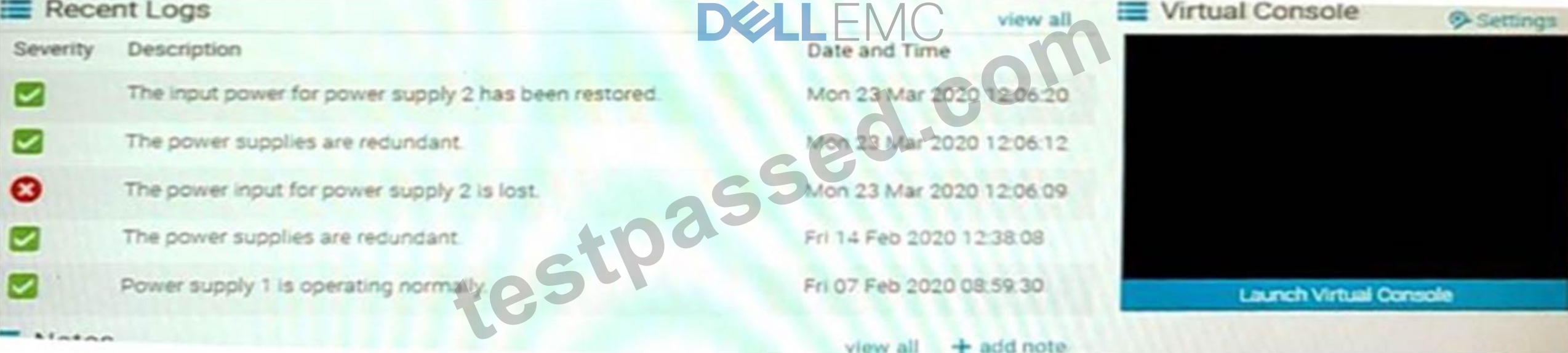
What happened on April 30, 2019? Note: It is necessary to dose (x) the simulator window before you can select a response to this question.

- A. Option C
- B. Option A
- C. Option D
- D. Option B
Answer: A
NEW QUESTION # 36
A technician installs a PCIe card into a server, but the card does not appear in the OS. The server does not have an LCD to display errors, but a light is flashing on the front of the server.
What actions can the technician take to troubleshoot the issue?
- A. Review the Lifecycle Controller log for errors Check PCIe Bus Log for errors
- B. Initiate Hardware Stress Test from iDRAC GUI
Check PCIe Bus Log for errors - C. Run Hardware Diagnostics from Lifecycle Controller
Review the Lifecycle Controller log for errors - D. Run Hardware Diagnostics from Lifecycle Controller
Initiate Hardware Stress Test from iDRAC GUI
Answer: C
NEW QUESTION # 37
A user is getting an error message when attempting to attach an ISO image file through Virtual Console. Virtual media is currently unavailable.
What is the cause of this error?
- A. Virtual media is mounted over a weak WAN connection.
- B. Remote file share (RFS) connection is active.
- C. Unsupported image file format is used.
Answer: B
NEW QUESTION # 38
Which iDRAC feature allows users to view video recordings of the last three power cycles?
- A. Diagnostics
- B. Boot and Crash Capture
- C. System debug logs
- D. Virtual Console
Answer: B
NEW QUESTION # 39
A system board was replaced. After the replacement, the system will NOT boot into Windows and gives the error 'No boot device found'. Virtual disks are seen and optimal.
What action should a technician take to resolve this issue?
- A. Reseat the RAID chain
- B. Make sure that the iDRAC license was imported
- C. Change the boot settings from BIOS to UEFI
- D. Insert the Windows media to fix the MBR
Answer: C
NEW QUESTION # 40
A technician needs to update the iDRAC license on a PowerEdge R740 server from Express to Enterprise.
The server has the following components:
- 2x CPUs
- 384 GB RAM
- 6x 1 TB drives
- 1x PSU
The server is powered down but connected to active AC. The user wants it to stay powered down and not connect to any networks. No errors are presently displayed.
How can the technician upgrade the license?
- A. Power on the server then connect to the iDRAC and upgrade iDRAC license before powering the server down
- B. The license cannot be upgraded on a single PSU system
- C. Connect to the iDRAC GUI and upgrade the iDRAC license while the server is powered down.
- D. The license cannot be upgraded because the user will not allow the server to be powered on
Answer: C
NEW QUESTION # 41
A technician wants to install a new version of OMSA onto a server that already has an existing version of OMSA.
What is required for this new installation?
- A. iSM must also be installed on the managed server
- B. iDRAC firmware needs to be at version 5.0 or higher
- C. Existing OMSA must be uninstalled before the new version is installed
- D. Existing OMSA version must be disabled in Services
Answer: C
NEW QUESTION # 42
An engineer needs to install an additional PSU on an existing, single PSU Dell EMC PowerEdge R740. They complete the initial installation and cabling procedures. They connect an AC cable and the power distribution unit produces normal AC output. The engineer checks power management and sees that the new PSU is in the Failed state.
What task should be completed to troubleshoot this issue?
- A. Verify the new PSU is the same type and wattage rating
- B. Set the PSU AC redundancy to 1+1
- C. Confirm the System Input Power CAP is not set to Low
- D. Set the PSU AC redundancy to 1+0
Answer: A
NEW QUESTION # 43
A technician is tasked to perform a RAID Level Migration (RLM) of a RAID 5 array to a RAID 6 array.
They back up data and look in iDRAC Storage and find that the current RAID 5 array is sliced into two virtual disks.
What should the technician do to achieve the desired RAID level?
- A. Use SupportAssist Enterprise to complete RAID migration
- B. Reboot and press Ctrl-R to complete RAID migration
- C. Open the OpenManage Enterprise GUI, delete the arrays, and recreate the new RAID 6 array
- D. Use iDRAC GUI under Storage Configuration to delete the arrays and recreate the new RAID 6 array
Answer: D
NEW QUESTION # 44
The Dell PowerEdge R660 sei /ei is not responding during POST.
What can the system administrator do to enter BIOS progress mode?
- A. Press and hold the System ID button for more than five seconds.
- B. Enter <F2> when the server tries to POST.
- C. Press and hold the power button for 15 seconds.
- D. Disconnect and reconnect the power cables for both PSUs.
Answer: A
Explanation:
Entering BIOS Progress Mode on a Non-Responsive Dell PowerEdge R660 During POST Server Troubleshooting (32%)
* Explain Configuration Validation, crash capture, and minimum to POST
* Analyze the visual indicators on server components - system ID, PSU, and BLINK Understanding the Scenario
* Server Model:Dell PowerEdge R660
* Issue:Not responding during POST (Power-On Self-Test)
* Objective:Enter BIOS Progress Mode to troubleshoot the issue
What is BIOS Progress Mode?
BIOS Progress Mode is a diagnostic feature that allows the system to display detailed POST codes and progress indicators during the boot process. This can help administrators identify where the boot process is stalling.
How to Enter BIOS Progress Mode
* Method:Press and hold theSystem ID buttonfor more than five seconds during the boot process.
* Effect:
* Forces the server into BIOS Progress Mode.
* Displays detailed POST information on the screen.
* Helps in diagnosing issues that prevent the server from completing POST.
Explanation of Options
* Option A: Press and hold the power button for 15 seconds.
* Analysis:
* Holding the power button for an extended period typically forces a hard shutdown or initiates a power reset.
* Does not help in entering BIOS Progress Mode.
* Conclusion:Incorrect.
* Option B: Enter <F2> when the server tries to POST.
* Analysis:
* Pressing <F2> during POST is the standard method to enter the BIOS Setup Utility.
* However, if the server is not responding during POST, this method may not be effective.
* Does not specifically enable BIOS Progress Mode.
* Conclusion:Less effective.
* Option C: Press and hold the System ID button for more than five seconds.
* Analysis:
* Pressing and holding the System ID button for over five seconds triggers the server to enter BIOS Progress Mode.
* This method is designed for situations where the server is unresponsive during POST.
* Conclusion:Correct Answer.
* Option D: Disconnect and reconnect the power cables for both PSUs.
* Analysis:
* Power cycling the server by disconnecting and reconnecting power may not resolve POST issues.
* Does not enable BIOS Progress Mode.
* Conclusion:Unlikely to help.
Dell Operate References
* Server Troubleshooting (32%)
* Explain Configuration Validation, crash capture, and minimum to POST:
* Understanding how to enter BIOS Progress Mode is essential for diagnosing POST-related issues.
* Analyze the visual indicators on server components - system ID, PSU, and BLINK:
* System ID Button:
* Located on the front panel of the server.
* Serves multiple functions, including identifying the server in a rack and triggering diagnostic modes.
* System Administration (18%)
* Configure BIOS, Storage, virtual media, networking, user access, lockdown mode, and group management:
* Familiarity with BIOS access methods and diagnostic tools is crucial for system administrators.
Conclusion
When a Dell PowerEdge R660 server is not responding during POST, pressing and holding theSystem ID buttonfor more than five seconds will force the server intoBIOS Progress Mode. This allows the administrator to see detailed POST codes and identify where the boot process is failing.
NEW QUESTION # 45
A Dell EMC PowerEdge 14G server uses Intel OPTANE DC Persistent Memory in Memory mode.
What is the minimum size DIMM supported for this type of memory?
- A. 128 GB
- B. 256 GB
- C. 512 GB
- D. 64 GB
Answer: A
NEW QUESTION # 46
A PowerEdge server is running a hypervisor. The server must be configured to enable multiple virtual machines to share the PCIs hardware resources of a supported NIC.
Which System BIOS setting must be enabled to provide this functionality?
- A. Single Root I/O Virtualization
- B. DirectPath I/O
- C. Memory Mapped I/O above 4 GB
- D. Virtualization Technology
Answer: B
NEW QUESTION # 47
A technician needs to change the iDRAC password on a Dell EMC PowerEdge 14G server in a lights- out datacenter. The be rebooted because it is in production. The iDRAC is configured with the default credentials.
How could the technician change the iDRAC password?
- A. OpenManage Server Administrator
- B. Virtual Console; press F2 after rebooting system
- C. SupportAssist Enterprise
- D. iDRAC Web GUI
Answer: C
NEW QUESTION # 48
An administrator is in a non-secure location with a high latency connection. What option should be used to recover a PowerEdge server using an existing server profile?
- A. RACADM
- B. IPMI
- C. iDRAC
- D. Redfish
Answer: A
Explanation:
Selecting the Appropriate Recovery Tool
Server Management and Configuration Tools (14%)
* Explain the management interface options - LCC, racadm, OMSA, iSM, OME Scenario Analysis
* Constraints:
* Non-secure location: Security of the connection is a concern.
* High latency connection: Requires a tool that operates efficiently over slow networks.
* Objective: Recover a PowerEdge server using an existing server profile.
Option Evaluations
* Option A: iDRAC
* Analysis: While iDRAC provides remote management, accessing it via a web interface may be slow and less secure in high latency and non-secure environments.
* Option B: Redfish
* Analysis: Redfish uses HTTPS, which is secure but may not perform well over high latency connections and requires more overhead.
* Option C: IPMI
* Analysis: IPMI lacks robust security features and is not recommended in non-secure locations.
* Option D: RACADM
* Correct Answer
* Advantages:
* Secure: Can use SSH for secure command-line access.
* Efficient: Command-line interface minimizes bandwidth usage, suitable for high latency.
* Powerful: Allows full management of the server, including applying existing server profiles.
* Scriptable: Enables automation and faster recovery processes.
Understanding RACADM
* RACADM (Remote Access Controller Admin):
* A command-line utility for managing Dell servers via iDRAC.
* Supports both local and remote management.
* Ideal for automated scripts and low-bandwidth situations.
Dell Operate References
* Server Management and Configuration Tools (14%)
* Emphasizes understanding different management tools and their appropriate use cases.
* System Administration (18%)
* Covers configuring and managing servers in various environments.
Conclusion
Given the need for a secure and efficient tool in a high latency and non-secure location,RACADMis the optimal choice for recovering the PowerEdge server using an existing server profile.
NEW QUESTION # 49
A system administrator needs to install OpenManage Server Administrator on 200 servers.
What is the quickest way to meet this requirement?
- A. Use Microsoft utilities to automate the deployment of OpenManage Server Administrator.
- B. Install OME and push OpenManage Server Administrator to all 200 servers.
- C. Download OpenManage Server Administrator from Dell.com and install on each server.
- D. Use the Lifecycle Controller to install OpenManage Server Administrator on each server.
Answer: B
NEW QUESTION # 50
Which component of the Dell EMC PowerEdge server provides system information, status, and error messages to indicate when the system is operating correctly, or when the system needs attention?
- A. UEFI
- B. Front Panel LCD
- C. BIOS
- D. RACADM
Answer: B
NEW QUESTION # 51
A customer acquired six R750 servers. They must add these servers to their existing R760 iDRAC Group but are encountering errors.
What is the reason for the errors?
- A. The feature requires iDRAC Enterprise.
- B. R750 iDRACs firmware is out of date.
- C. R750 iDRACs are not running the same version of firmware.
- D. 15G and 16G servers cannot be in the same group.
Answer: D
Explanation:
Understanding iDRAC Group Management and Compatibility
Server Management and Configuration Tools (14%)
* Define the function of the iDRAC, login procedures, licensing, and connection methods
* Explain the management interface options - LCC, racadm, OMSA, iSM, OME System Administration (18%)
* Configure BIOS, Storage, virtual media, networking, user access, lockdown mode, and group management Scenario Analysis The customer has acquired sixDell PowerEdge R750servers and wants to add them to an existingiDRAC Groupthat currently containsR760servers. However, they are encountering errors during this process.
Understanding Dell Server Generations
* PowerEdge R750: Part of the15th Generation (15G)servers.
* PowerEdge R760: Part of the16th Generation (16G)servers.
iDRAC Group Manager Limitations
* iDRAC Group Managerallows administrators to manage multiple servers from a single interface.
* Important Limitation:Servers of different generations cannot be grouped togetherin iDRAC Group Manager.
* This is due to differences in firmware, hardware capabilities, and iDRAC features between server generations.
* Impact: Attempting to add 15G servers (R750) to a group containing 16G servers (R760) will result in errors.
Evaluation of Options
* Option A: R750 iDRACs firmware is out of date
* Analysis: While outdated firmware can cause issues, it is not the primary reason here. Firmware updates would not resolve the incompatibility between different server generations.
* Option B: R750 iDRACs are not running the same version of firmware
* Analysis: Similar to Option A, firmware version mismatches can cause problems but not errors related to grouping different generations.
* Option C: 15G and 16G servers cannot be in the same group
* Correct answer: This is the primary reason for the errors encountered.
* Option D: The feature requires iDRAC Enterprise
* Analysis: Since the customer already has an existing iDRAC group with R760 servers, they likely have the necessary licensing.
Dell Operate References
* Server Management and Configuration Tools (14%)
* Emphasizes understanding iDRAC functionalities and limitations.
* System Administration (18%)
* Highlights the importance of group management and its constraints.
Conclusion
The errors occur because iDRAC Group Manager does not support grouping servers from different generations. The customer cannot add 15G servers (R750) to a group that contains 16G servers (R760).
NEW QUESTION # 52
A Dell EMC PowerEdge R740 server requires a vFlash SD card urgently. Additional vFlash Cards and components from other servers are available.
What is the recommended solution?
- A. Reuse an existing vFlash SD card from a 14G server
- B. Use a configuration option to convert BOSS to a virtual vFlash
- C. Reuse an existing vFlash SD card from either a 13G or 14G server
- D. Use a configuration option to convert an NVMe drive to a virtual vFlash
Answer: A
NEW QUESTION # 53
A technician is troubleshooting a server with the following components:
Two CPUs
Memory installed in sockets A1, A2, A3, A4, A5, A6, B1, B2, B3, B4, B5 and B6 Expansion cards installed in all expansion slots
6x 1 TB drives configured as a RAID 6 virtual disk
The server has the following symptoms:
CPU2 has failed
Memory in slots B1, B2, B3, B4, B5 and B6 is not accessible
Some of the expansion cards have gone offline.
What should the technician do to resolve this issue?
- A. Replace CPU2
- B. Replace the failing CPU, failing memory, and expansion cards
- C. Reboot the server, access the Lifecycle and re-enable CPU2
- D. Replace the system board
Answer: A
NEW QUESTION # 54
A technician needs to install a server with a PERC RAID controller and 24, 2.5" SAS SED drives.
The installation requires the following items to be created:
- Three equal-sized virtual disks
- Encrypted virtual disks
- A global hot spare
In addition to selecting the physical drive to be the hot spare disk, what tasks should the technician perform to set up the RAID controller?
- A. Boot to Ctrl+R and create the three virtual disks
Select each physical drive and enable encryption - B. Access the iDRAC GUI and create the three virtual disks
Select each virtual disk and enable encryption - C. Boot to F12 and create the three virtual disks
Select each physical drive and enable encryption - D. Boot to F12 and create the three virtual disks
Select each virtual disk and enable encryption
Answer: B
NEW QUESTION # 55
......
EMC D-PE-OE-23 Exam Syllabus Topics:
| Topic | Details |
|---|---|
| Topic 1 |
|
| Topic 2 |
|
| Topic 3 |
|
| Topic 4 |
|
| Topic 5 |
|
D-PE-OE-23 Actual Questions Answers PDF 100% Cover Real Exam Questions: https://lead2pass.testpassed.com/D-PE-OE-23-pass-rate.html