


Dec 09, 2024 Updated HPE7-A02 Dumps Questions For HP Exam
Best Value Available Preparation Guide for HPE7-A02 Exam
HP HPE7-A02 certification exam is suitable for network security professionals who wish to enhance their skills and knowledge in the field of network security. It is also ideal for individuals who wish to advance their careers in network security, as it is a globally recognized certification that demonstrates a high level of expertise in network security.
NEW QUESTION # 32
A company is implementing HPE Aruba Networking Wireless IDS/IPS (WIDS/WIPS) on its AOS-10 APs, which are managed in HPE Aruba Networking Central.
What is one requirement for enabling detection of rogue APs?
- A. A Foundation with Security license for each of the APs
- B. One AM deployed for every one AP deployed
- C. A manual radio profile that enables non-regulatory channels
- D. Each VLAN in the network assigned on at least one AP's or AM's port
Answer: A
Explanation:
To enable the detection of rogue APs with HPE Aruba Networking Wireless IDS/IPS (WIDS/WIPS) on AOS-10 APs managed in HPE Aruba Networking Central, each AP must have a Foundation with Security license. This license enables advanced security features, including rogue AP detection, which is crucial for maintaining a secure wireless environment and protecting against unauthorized access points.
NEW QUESTION # 33
An AOS-CX switch has been configured to implement UBT to a cluster of three HPE Aruba Networking gateways.
How does the switch determine to which gateways to tunnel UBT users' traffic?
- A. The switch tunnels all users' traffic to the gateway assigned as the switch's active device designated gateway.
- B. The switch tunnels each user's traffic to the particular gateway assigned as that user's active user designed gateway.
- C. The switch tunnels all users' traffic to the gateway configured as the primary gateway in the UBT zone, unless that gateway fails.
- D. The switch load balances client traffic across the primary and standby gateway configured in the UBT zone.
Answer: B
Explanation:
When an AOS-CX switch implements User-Based Tunneling (UBT) to a cluster of three HPE Aruba Networking gateways, the switch determines to which gateway to tunnel each user's traffic based on the particular gateway assigned as that user's active user designated gateway. This ensures that traffic is efficiently distributed and managed according to the designated gateway for each user.
1.User Designated Gateway: Each user's traffic is tunneled to a specific gateway that has been designated for that user, ensuring efficient handling of traffic.
2.Traffic Distribution: This method allows for balanced distribution of user traffic across multiple gateways, enhancing network performance and reliability.
3.Gateway Assignment: The switch uses the assigned gateway for each user to determine the tunneling path, ensuring that traffic is directed to the appropriate gateway.
NEW QUESTION # 34
What is one use case for implementing user-based tunneling (UBT) on AOS-CX switches?
- A. Tunneling traffic directly to a third-party firewall in a client data center
- B. Centralizing the distribution of wired traffic without requiring HPE Aruba Networking gateways
- C. Adding 802.1X while continuing to use the existing VLAN and ACL structure in the Ethernet network
- D. Applying enhanced security features such as deep packet inspection (DPI) to wired traffic
Answer: D
Explanation:
Implementing user-based tunneling (UBT) on AOS-CX switches is beneficial for applying enhanced security features such as deep packet inspection (DPI) to wired traffic. UBT allows the traffic from specific users or devices to be tunneled to a central controller or security appliance where advanced security policies, including DPI, can be applied. This approach ensures that even wired traffic benefits from the same level of security and inspection typically available for wireless traffic, thus enhancing overall network security.
NEW QUESTION # 35
What is a use case for running periodic subnet scans on devices from HPE Aruba Networking ClearPass Policy Manager (CPPM)?
- A. Identifying issues with authenticating and authorizing clients
- B. Using DHCP fingerprints to determine a client's device category and OS
- C. Using WMI to collect additional information about Windows domain clients
- D. Detecting devices that fail to comply with rules defined in CPPM posture policies
Answer: B
Explanation:
Running periodic subnet scans on devices from HPE Aruba Networking ClearPass Policy Manager (CPPM) can be used to gather DHCP fingerprints, which help determine a client's device category and operating system. DHCP fingerprints are unique patterns in DHCP request packets that provide valuable information about the device type and OS, assisting in device profiling and policy enforcement.
1.DHCP Fingerprinting: This technique captures specific details from DHCP packets to identify the type and operating system of a device.
2.Device Profiling: By running subnet scans, CPPM can continuously update its device database with accurate profiles, ensuring that policies are applied correctly based on the device type.
3.Network Visibility: Regular scanning helps maintain up-to-date visibility of all devices on the network, improving security and management.
NEW QUESTION # 36
A company has HPE Aruba Networking APs running AOS-10 that connect to AOS-CX switches. The APs will:
. Authenticate as 802.1X supplicants to HPE Aruba Networking ClearPass Policy Manager (CPPM)
. Be assigned to the "APs" role on the switches
. Have their traffic forwarded locally
What information do you need to help you determine the VLAN settings for the "APs" role?
- A. Whether the switches have established tunnels with an HPE Aruba Networking gateway
- B. Whether the APs bridge or tunnel traffic on their SSIDs
- C. Whether the APs have static or DHCP-assigned IP addresses
- D. Whether the switches are using local user-roles (LURs) or downloadable user-roles (DURs)
Answer: B
Explanation:
To determine the VLAN settings for the "APs" role on AOS-CX switches, it is crucial to know whether the APs bridge or tunnel traffic on their SSIDs. If the APs are bridging traffic, the VLAN settings on the switch need to align with the VLANs used by the SSIDs. If the APs are tunneling traffic to a controller or gateway, the VLAN settings might differ as the traffic is encapsulated and forwardedthrough the tunnel. Understanding this aspect ensures that the VLAN configuration on the switches correctly supports the traffic forwarding method employed by the APs.
NEW QUESTION # 37
Assume that an AOS-CX switch is already implementing DHCP snooping and ARP inspection successfully on several VLANs.
What should you do to help minimize disruption time if the switch reboots?
- A. Save the IP-to-MAC bindings to external storage.
- B. Configure the switch to act as an ARP proxy.
- C. Create static IP-to-MAC bindings for the DHCP and DNS servers.
- D. Configure the IP helper address on this switch, rather than a core routing switch.
Answer: A
Explanation:
To minimize disruption time if an AOS-CX switch reboots while implementing DHCP snooping and ARP inspection, you should save the IP-to-MAC bindings to external storage. This ensures that the DHCP snooping and ARP inspection tables, which are crucial for preventing spoofing attacks, are preserved across reboots. When the switch restarts, it can reload these bindings from the external storage, thereby maintaining network security and reducing the downtime associated with rebuilding these tables.
1.Preserving Bindings: Saving IP-to-MAC bindings to external storage ensures that these critical security tables are not lost during a reboot, maintaining network integrity.
2.Security Continuity: This practice helps to quickly restore security features like DHCP snooping and ARP inspection, minimizing the window of vulnerability.
3.Operational Efficiency: By preserving these bindings, the switch can resume normal operations faster, reducing disruption to network services.
NEW QUESTION # 38 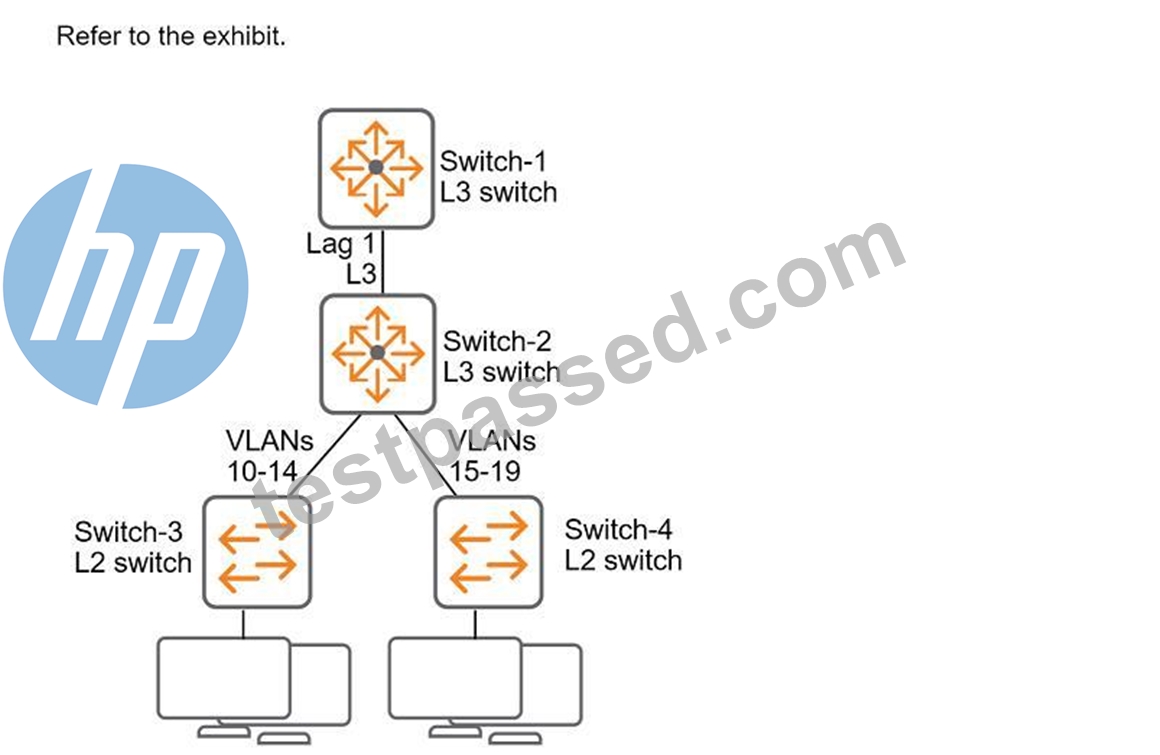
All of the switches in the exhibit are AOS-CX switches.
What is the preferred configuration on Switch-2 for preventing rogue OSPF routers in this network?
- A. Configure OSPF authentication on VLANs 10-19 in password mode.
- B. Configure passive-interface as the OSPF default and disable OSPF passive on Lag 1.
- C. Disable OSPF entirely on VLANs 10-19.
- D. Configure OSPF authentication on Lag 1 in MD5 mode.
Answer: D
Explanation:
To prevent rogue OSPF routers in the network shown in the exhibit, the preferred configuration on Switch-2 is to configure OSPF authentication on Lag 1 in MD5 mode. This setup enhances security by ensuring that only routers with the correct MD5 authentication credentials can participate in the OSPF routing process.
This method protects the OSPF sessions against unauthorized devices that might attempt to introduce rogue routing information into the network.
1.OSPF Authentication: Implementing MD5 authentication on Lag 1 ensures that OSPF updates are secured with a cryptographic hash. This prevents unauthorized OSPF routers from establishing peering sessions and injecting potentially malicious routing information.
2.Secure Communication: MD5 authentication provides a higher level of security compared to simple password authentication, as it uses a more robust hashing algorithm.
3.Applicability: Lag 1 is the primary link between Switch-1 and Switch-2, and securing this link helps protect the integrity of the OSPF routing domain.
NEW QUESTION # 39
A company has HPE Aruba Networking APs running AOS-10 and managed by HPE Aruba Networking Central. The company also has AOS-CX switches. The security team wants you to capture traffic from a particular wireless client. You should capture this client's traffic over a 15 minute time period and then send the traffic to them in a PCAP file.
What should you do?
- A. Go to that client in HPE Aruba Networking Central. Use the "Live Events" page to run a packet capture.
- B. Access the CLI for the client's AP. Set up a mirroring session between its radio and a management station running Wireshark.
- C. Access the CLI for the client's AP's switch. Set up a mirroring session between the AP's port and a management station running Wireshark.
- D. Go to the client's AP in HPE Aruba Networking Central. Use the "Security" page to run a packet capture.
Answer: D
Explanation:
To capture traffic from a particular wireless client for a 15-minute period and then send the traffic in a PCAP file, you should go to the client's AP in HPE Aruba Networking Central and use the "Security" page to run a packet capture. This method allows you to directly capture the client's traffic from the AP managing the wireless connection, ensuring that you gather the relevant traffic data for analysis.
1.Centralized Management: HPE Aruba Networking Central provides a centralized interface for managing and monitoring APs, making it easy to initiate packet captures.
2.Security Page: The "Security" page in Aruba Central includes tools for running packet captures, allowing you to specify the duration and other parameters.
3.Ease of Use: This approach simplifies the process by using the built-in features of Aruba Central, avoiding the need for complex CLI commands or additional hardware.
NEW QUESTION # 40
What is a use case for the HPE Aruba Networking ClearPass OnGuard dissolvable agent?
- A. Continuously monitoring Windows domain clients for compliance
- B. Auto-remediating posture issues on clients
- C. Periodically scanning Linux clients for security issues
- D. Implementing a one-time compliance scan
Answer: D
Explanation:
The use case for the HPE Aruba Networking ClearPass OnGuard dissolvable agent is implementing a one-time compliance scan. The dissolvable agent is designed to perform a compliance check without requiring a permanent installation on the client device. This is ideal for environments where a quick, temporary assessment of the device's security posture is needed without the overhead of a persistent agent.
1.Dissolvable Agent: The dissolvable agent is downloaded and executed on the client device for a single session, performing the necessary compliance checks before being removed automatically.
2.One-time Compliance Scan: This method is particularly useful for guest or unmanaged devices where a temporary compliance scan is sufficient to ensure security standards are met.
3.Minimal Impact: Since the agent does not persist on the client device, it minimizes the impact on the user's system and does not require ongoing maintenance or updates.
NEW QUESTION # 41
You are using OpenSSL to obtain a certificate signed by a Certification Authority (CA). You have entered this command:
openssl req -new -out file1.pem -newkey rsa:3072 -keyout file2.pem
Enter PEM pass phrase: **********
Verifying - Enter PEM pass phrase: **********
Country Name (2 letter code) [AU]:US
State or Province Name (full name) [Some-State]:California
Locality Name (eg, city) []:Sunnyvale
Organization Name (eg, company) [Internet Widgits Pty Ltd]:example.com
Organizational Unit Name (eg, section) []:Infrastructure
Common Name (e.g. server FQDN or YOUR name) []:radius.example.com
What is one guideline for continuing to obtain a certificate?
- A. You should use a third-party tool to encrypt file2.pem before sending it and file1.pem to the CA.
- B. You should submit file1.pem, but not file2.pem, to the desired CA to sign.
- C. You should submit file2.pem, but not file1.pem, to the desired CA to sign.
- D. You should concatenate file1.pem and file2.pem into a single file, and submit that to the desired CA to sign.
Answer: B
Explanation:
When using OpenSSL to obtain a certificate signed by a Certification Authority (CA), you should submit the Certificate Signing Request (CSR) file, which is file1.pem, to the CA. The CSR contains the information about the entity requesting the certificate and the public key, but not the private key, which is in file2.pem.
The CA uses the information in the CSR to create and sign the certificate.
1.CSR Submission: The CSR (file1.pem) includes the public key and the entity information required by the CA to issue a certificate.
2.Private Key Security: The private key (file2.pem) should never be sent to the CA or shared; it remains securely stored on the requestor's server.
3.Certificate Issuance: After the CA signs the CSR, the resulting certificate can be used with the private key to establish secure communications.
NEW QUESTION # 42
You need to set up an HPE Aruba Networking VIA solution for a customer who needs to support 2100 remote employees. The customer wants employees to download their VIA connection profile from the VPNC. Only employees who authenticate with their domain credentials to HPE Aruba Networking ClearPass Policy Manager (CPPM) should be able to download the profile. (A RADIUS server group for CPPM is already set up on the VPNC.) How do you configure the VPNC to enforce that requirement?
- A. Set up a VIA Authentication Profile that uses CPPM's server group; reference that profile in the VIA Web Authentication Profile.
- B. Reference CPPM's server group in an AAA profile; then, apply that profile to the VPNC's Internet-facing ports.
- C. Create a new VPN Authentication Profile and then reference CPPM's default server group in that profile.
- D. Set up a VIA Authentication Profile that uses CPPM's server group; reference that profile in the VIA Connection Profile.
Answer: A
Explanation:
To configure the HPE Aruba Networking VIA solution for remote employees who need to download their VIA connection profile from the VPN Concentrator (VPNC) and ensure that only those who authenticate with their domain credentials through ClearPass Policy Manager (CPPM) can do so, you need to set up a VIA Authentication Profile. This profile should use the CPPM's RADIUS server group. Once the VIA Authentication Profile is created, you need to reference this profile in the VIA Web Authentication Profile.
This configuration ensures that the authentication process requires employees to validate their credentials via CPPM before they can download the VIA connection profile.
NEW QUESTION # 43
A company is implementing a client-to-site VPN based on tunnel-mode IPsec.
Which devices are responsible for the IPsec encapsulation?
- A. Gateways at the remote clients' locations and devices accessed by the clients at the main site
- B. The remote clients and a gateway at the main site
- C. Gateways at the remote clients' locations and a gateway at the main site
- D. The remote clients and devices accessed by the clients at the main site
Answer: B
Explanation:
In a client-to-site VPN based on tunnel-mode IPsec, the remote clients and a gateway at the main site are responsible for the IPsec encapsulation. The remote clients initiate the VPN connection and encapsulate their traffic in IPsec, which is then decapsulated by the gateway at the main site.
1.IPsec Encapsulation: The remote clients encapsulate their traffic using IPsec protocols before sending it over the internet to the main site.
2.Gateway Role: The gateway at the main site receives the encapsulated traffic, decapsulates it, and forwards it to the internal network. Similarly, traffic from the main site to the remote clients is encapsulated by the gateway and decapsulated by the clients.
3.Security: This setup ensures that data is securely transmitted between the remote clients and the main site, protecting it from eavesdropping and tampering.
NEW QUESTION # 44
HPE Aruba Networking ClearPass Policy Manager (CPPM) uses a service to authenticate clients. You are now adding the Endpoints Repository as an authorization source for the service, and you want to add rules to the service's policies that apply different access levels based, in part, on a client's device category. You need to ensure that CPPM can apply the new correct access level after discovering new clients' categories.
What should you enable on the service?
- A. The Audit End-host option in the Service tab
- B. The Profile Endpoints option in the Service tab
- C. The Posture Compliance option in the Service tab
- D. The Use cached Roles and Posture attributes from previous sessions option in the Enforcement tab
Answer: B
Explanation:
To ensure that HPE Aruba Networking ClearPass Policy Manager (CPPM) can apply the correct access levels based on a client's device category after discovering new clients, you need to enable the "Profile Endpoints" option in the Service tab. This option allows CPPM to profile and categorize endpoints dynamically, ensuring that the appropriate access levels are applied based on the device's characteristics.
Enabling this feature ensures that new devices are accurately profiled and that access policies can be enforced based on the updated device information.
NEW QUESTION # 45
Which use case is fulfilled by applying a time range to a firewall rule on an AOS device?
- A. Setting the time range over which hit counts for the rule are aggregated
- B. Tuning the session timeout for sessions established with this rule
- C. Enforcing the rule only during the specified time range
- D. Locking clients that violate the rule for the specified time range
Answer: C
Explanation:
Applying a time range to a firewall rule on an AOS device fulfills the use case of enforcing the rule only during the specified time range. This allows administrators to control when specific firewall rules are active, which can be useful for implementing policies that only need to be in effect during certain hours, such as blocking or allowing access to specific resources outside of business hours.
1.Time-Based Enforcement: The firewall rule will be active only during the specified time range, ensuring that the rule's policies are enforced only when needed.
2.Use Case: This feature is useful for scenarios like limiting access to certain applications or websites during working hours, or enabling enhanced security measures during off-hours.
3.Flexibility: Provides flexibility in security policy management by allowing dynamic adjustment of rules based on time schedules.
NEW QUESTION # 46
A company needs you to integrate HPE Aruba Networking ClearPass Policy Manager (CPPM) with HPE Aruba Networking ClearPass Device Insight (CPDI).
What is one task you should do to prepare?
- A. Configure WMI, SSH, and SNMP external accounts for device scanning on CPPM.
- B. Collect a Data Collector token from HPE Aruba Networking Central.
- C. Enable Insight in the CPPM server configuration settings.
- D. Install the root CA for CPPM's HTTPS certificate as trusted in the CPDI application.
Answer: C
Explanation:
To integrate HPE Aruba Networking ClearPass Policy Manager (CPPM) with HPE Aruba Networking ClearPass Device Insight (CPDI), one of the necessary tasks is to enable Insight in the CPPM server configuration settings. This configuration allows CPPM to communicate and share data with CPDI, facilitating the integration and enabling enhanced device profiling and policy enforcement capabilities.
1.Insight Enablement: Enabling Insight on the CPPM server allows it to leverage the data and capabilities of CPDI, integrating device profiling information into policy decisions.
2.Data Sharing: This integration ensures that CPPM can receive and use detailed device information from CPDI to make more informed policy enforcement decisions.
3.Configuration: Properly configuring the server settings to enable Insight ensures seamless communication and data flow between CPPM and CPDI.
NEW QUESTION # 47
A company wants HPE Aruba Networking ClearPass Policy Manager (CPPM) to respond to Syslog messages from its Palo Alto Next Generation Firewall (NGFW) by quarantining clients involved in security incidents.
Which step must you complete to enable CPPM to process the Syslogs properly?
- A. Configure CPPM to trust the root CA certificate for the NGFW.
- B. Enable Insight and ingress event processing on the CPPM server.
- C. Configure the Palo Alto as a context server on CPPM.
- D. Install a Palo Alto Extension through ClearPass Guest.
Answer: C
Explanation:
To enable HPE Aruba Networking ClearPass Policy Manager (CPPM) to process Syslog messages from a Palo Alto Next Generation Firewall (NGFW) and quarantine clients involved in security incidents, you need to configure the Palo Alto as a context server on CPPM. This setup allows CPPM to receive and understand the context of the Syslog messages sent by the Palo Alto NGFW, enabling it to take appropriate actions such as quarantining clients.
1.Context Server Configuration: Configuring the Palo Alto NGFW as a context server in CPPM ensures that CPPM can process and respond to Syslog messages effectively.
2.Security Incident Response: By understanding the context of the Syslog messages, CPPM can automatically trigger actions like client quarantine based on security incidents detected by the NGFW.
3.Integration: This integration enhances the overall security posture by enabling coordinated responses between the firewall and CPPM.
NEW QUESTION # 48
......
Full HPE7-A02 Practice Test and 72 Unique Questions, Get it Now!: https://lead2pass.testpassed.com/HPE7-A02-pass-rate.html