


[Jun-2025] Download Real HP HPE7-A02 Exam Dumps Test Engine Exam Questions
New HPE7-A02 exam dumps Use Updated HP Exam
NEW QUESTION # 67
What is one use case for implementing user-based tunneling (UBT) on AOS-CX switches?
- A. Applying enhanced security features such as deep packet inspection (DPI) to wired traffic
- B. Centralizing the distribution of wired traffic without requiring HPE Aruba Networking gateways
- C. Tunneling traffic directly to a third-party firewall in a client data center
- D. Adding 802.1X while continuing to use the existing VLAN and ACL structure in the Ethernet network
Answer: A
Explanation:
Implementing user-based tunneling (UBT) on AOS-CX switches is beneficial for applying enhanced security features such as deep packet inspection (DPI) to wired traffic. UBT allows the traffic from specific users or devices to be tunneled to a central controller or security appliance where advanced security policies, including DPI, can be applied. This approach ensures that even wired traffic benefits from the same level of security and inspection typically available for wireless traffic, thus enhancing overall network security.
NEW QUESTION # 68
Refer to the exhibit.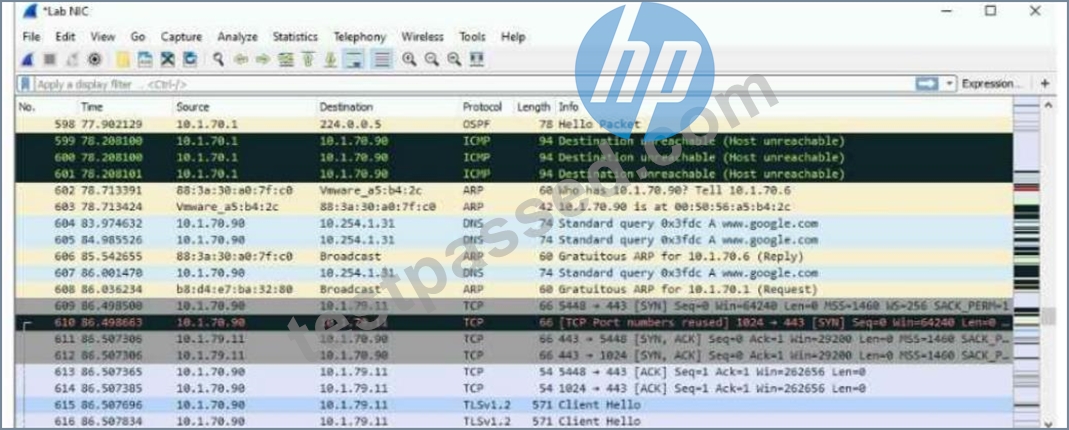
The exhibit shows a saved packet capture, which you have opened in Wireshark. You want to focus on the complete conversation between 10.1.70.90 and 10.1.79.11 that uses source port 5448.
What is a simple way to do this in Wireshark?
- A. Right-click one of the packets between those addresses and choose to follow the stream.
- B. Apply a capture filter that selects for both the 10.1.70.90 and 10.1.79.11 IP addresses.
- C. Apply a capture filter that selects for TCP port 5448.
- D. Click the Source column and then the Destination column to sort the packets into the desired order.
Answer: A
Explanation:
* Wireshark: Follow TCP Stream:
* Wireshark provides an intuitive feature to filter and display a complete TCP conversation.
* By right-clicking any packet within the conversation and selecting "Follow # TCP Stream", Wireshark isolates and displays the entire conversation.
* This feature allows you to view the communication in a simplified, sequential manner, including requests and responses.
* Option Analysis:
* Option A: Incorrect. Capture filters only apply during packet capturing, not for analyzing already saved packet captures.
* Option B: Incorrect. Sorting packets helps with organizing data but does not isolate a complete conversation.
* Option C: Incorrect. A capture filter for TCP port 5448 would have to be applied before capturing; it does not work for saved data.
* Option D: Correct. Right-clicking a packet and choosing "Follow TCP Stream" is the simplest way to display the full conversation between 10.1.70.90 and 10.1.79.11 on port 5448.
Steps in Wireshark to Follow a TCP Stream:
* Locate any packet within the desired conversation (e.g., between 10.1.70.90 and 10.1.79.11 on TCP port 5448).
* Right-click on the packet.
* Choose "Follow" # "TCP Stream".
* Wireshark will display the entire TCP conversation, including both directions of communication.
This feature is especially useful when troubleshooting or analyzing detailed interactions between hosts.
NEW QUESTION # 69
A company has HPE Aruba Networking Central-managed APs. The company wants to block all clients connected through the APs from using YouTube.
Which steps should you take?
- A. Deploy gateways and have the APs tunnel traffic to the gateways. Then, enable the gateway IDS/IPS engine.
- B. Enable WebCC on all client firewall roles. Then, create WebCC category rules that deny suspicious URLs.
- C. Enable DPI. Then, create application rules to deny YouTube on the firewall roles.
- D. Enable Client IPS at the "custom" level, and then specify the check for YouTube.
Answer: C
Explanation:
To block all clients connected through HPE Aruba Networking Central-managed APs from accessing YouTube, you should enable DPI (Deep Packet Inspection) and then create application rules to deny YouTube on the firewall roles. DPI allows the network to inspect and classify traffic based on application signatures, making it possible to enforce application-specific policies. By creating rules that specifically block YouTube traffic, you can effectively prevent clients from accessing the service.
NEW QUESTION # 70
A company is using HPE Aruba Networking Central SD-WAN Orchestrator to establish a hub-spoke VPN between branch gateways (BGWs) at 1444 site and VPNCs at multiple data centers.
What is part of the configuration that admins need to complete?
- A. In BGWs' and VPNCs' groups, create default IKE policies for the SD-WAN Orchestrator to use.
- B. At the global level, create default IPsec policies for the SD-WAN Orchestrator to use.
- C. In BGWs' groups, select the VPNCs to which to connect in a DC preference list.
- D. In VPNCs' groups, establish VPN pools to control which branches connect to which VPNCs.
Answer: C
Explanation:
When using HPE Aruba Networking Central SD-WAN Orchestrator to establish a hub-spoke VPN between branch gateways (BGWs) and VPN concentrators (VPNCs) at multiple data centers, admins need to configure the BGWs' groups by selecting the VPNCs to which they should connectin a Data Center (DC) preference list. This configuration ensures that branch gateways are properly directed to the preferred VPN concentrators, optimizing the hub-spoke VPN topology.
1.DC Preference List: This list allows administrators to prioritize which data center VPNCs the BGWs should connect to, ensuring efficient routing and redundancy.
2.Hub-Spoke Configuration: Properly setting the DC preference list is essential for establishing the desired hub-spoke VPN architecture.
3.Optimized Connectivity: This setup helps in optimizing traffic flow and maintaining connectivity between branches and data centers.
NEW QUESTION # 71
A company already uses HPE Aruba Networking ClearPass Policy Manager (CPPM) as the RADIUS server for authenticating wireless clients with 802.1X. Now you are setting up 802.1X on AOS-CX switches to authenticate many of those same clients on wired connections. You decide to copy CPPM's wireless 802.1X service and then edit it with a new name and enforcement policy. What else must you change for authentication to work properly?
- A. Authentication source
- B. Service rules
- C. Role mapping policy
- D. Authentication methods
Answer: B
Explanation:
* 802.1X Service Rules:
* Service rules define the criteria for when a specific service applies (e.g., wireless vs. wired authentication).
* For wired 802.1X authentication to work properly, the service rules need to differentiate between wireless and wired connections.
* If you copy the wireless service, the rules likely still match wireless-specific criteria. These must be updated to include wired-specific conditions (e.g., NAS IP or port types).
* Option Analysis:
* Option A (Role mapping policy): Role mapping policies determine user roles based on attributes but are not critical for differentiating wired vs. wireless.
* Option B (Authentication methods): Authentication methods (e.g., EAP) remain the same for both wireless and wired 802.1X.
* Option C (Authentication source): Authentication sources (like AD or internal database) do not need to change.
* Option D (Service rules): Correct. Updating the service rules ensures the new 802.1X service applies specifically to wired connections.
NEW QUESTION # 72
A company wants to use HPE Aruba Networking ClearPass Policy Manager (CPPM) to profile Linux devices. You have decided to schedule a subnet scan of the devices' subnets. Which additional step should you complete before scheduling the scan?
- A. Enable the Data Port in the ClearPass server settings and connect that port to the network.
- B. Enable WMI probing in the cluster-wide parameters.
- C. Set up SSH accounts on CPPM and map them to the Linux devices' subnets.
- D. Configure SNMP in the network device settings for the switches that support the Linux devices.
Answer: A
Explanation:
* Subnet Scan Requirements for Profiling:
* For ClearPass to scan and profile devices in a subnet, the Data Port must be enabled on the ClearPass server and connected to the network.
* This ensures that ClearPass can send and receive the required packets for device discovery and profiling.
* Option Analysis:
* Option A: Incorrect. SSH accounts are not required for subnet scanning.
* Option B: Incorrect. WMI probing is for Windows systems, not Linux devices.
* Option C: Correct. The Data Port is essential for subnet scans and must be properly configured and connected.
* Option D: Incorrect. SNMP is used for network device monitoring, not Linux device profiling.
NEW QUESTION # 73
You need to create a rule in an HPE Aruba Networking ClearPass Policy Manager (CPPM) role mapping policy that references a ClearPass Device Insight Tag. Which Type (namespace) should you specify for the rule?
- A. Device
- B. Endpoint
- C. TIPS
- D. Application
Answer: B
Explanation:
* ClearPass Role Mapping Policy:
* The Endpoint namespace is used to reference attributes and tags related to endpoint devices.
* Device Insight Tags are part of endpoint profiling information and are stored in the Endpoint Repository.
* Option Analysis:
* Option A: Correct. The Endpoint namespace includes Device Insight Tags.
* Option B: Incorrect. TIPS refers to system attributes and configuration data, not endpoint tags.
* Option C: Incorrect. Device is not a valid namespace in this context.
* Option D: Incorrect. Application relates to application-level attributes, not Device Insight Tags.
NEW QUESTION # 74
A company has HPE Aruba Networking gateways that implement gateway IDS/IPS. Admins sometimes check the Security Dashboard, but they want a faster way to discover if a gateway starts detecting threats in traffic.
What should they do?
- A. Use Syslog to integrate the gateways with HPE Aruba Networking ClearPass Policy Manager (CPPM) event processing.
- B. Set up email notifications using HPE Aruba Networking Central's global alert settings.
- C. Set up Webhooks that are attached to the HPE Aruba Networking Central Threat Dashboard.
- D. Integrate HPE Aruba Networking ClearPass Device Insight (CPDI) with Central and schedule hourly reports.
Answer: B
Explanation:
1. The Need for Faster Threat Notifications
Admins need immediate alerts when threats are detected by the gateway's IDS/IPS functionality. Regularly checking the Security Dashboard is inefficient, so an automated notification system is essential for faster response times.
2. Explanation of Each Option
A: Set up Webhooks that are attached to the HPE Aruba Networking Central Threat Dashboard:
* Incorrect:
* Webhooks are useful for integrating alerts with third-party tools or custom workflows. However, setting up email notifications through global alert settings is faster and simpler for this purpose.
B: Use Syslog to integrate the gateways with HPE Aruba Networking ClearPass Policy Manager (CPPM) event processing:
* Incorrect:
* Syslog integration with CPPM is typically used for logging and correlating events, not for real- time notifications about threats.
* CPPM is better suited for policy enforcement, not instant threat alerts.
C: Set up email notifications using HPE Aruba Networking Central's global alert settings:
* Correct:
* HPE Aruba Networking Central has global alert settings that allow admins to configure email notifications for specific events, such as threat detection.
* This is the simplest and most effective way to ensure admins receive immediate notifications when threats are detected by the gateways.
D: Integrate HPE Aruba Networking ClearPass Device Insight (CPDI) with Central and schedule hourly reports:
* Incorrect:
* While CPDI integration provides enhanced device profiling, it is not directly tied to gateway IDS
/IPS threat detection.
* Hourly reports are not real-time notifications and would not meet the requirement for faster threat alerts.
Final Recommendation
Setting up email notifications through HPE Aruba Networking Central's global alert settings provides the most direct and efficient solution for immediate threat detection alerts.
References
* HPE Aruba Networking Central Alert Management Documentation.
* Aruba IDS/IPS and Security Dashboard Configuration Guide.
* Email Notification Setup for Aruba Central Threat Alerts.
NEW QUESTION # 75
A company has HPE Aruba Networking gateways that implement gateway IDS/IPS. Admins sometimes check the Security Dashboard, but they want a faster way to discover if a gateway starts detecting threats in traffic.
What should they do?
- A. Use Syslog to integrate the gateways with HPE Aruba Networking ClearPass Policy Manager (CPPM) event processing.
- B. Set up email notifications using HPE Aruba Networking Central's global alert settings.
- C. Set up Webhooks that are attached to the HPE Aruba Networking Central Threat Dashboard.
- D. Integrate HPE Aruba Networking ClearPass Device Insight (CPDI) with Central and schedule hourly reports.
Answer: B
NEW QUESTION # 76
A company has AOS-CX switches. The company wants to make it simpler and faster for admins to detect denial of service (DoS) attacks, such as ping or ARP floods, launched against the switches.
What can you do to support this use case?
- A. Implement ARP inspection on all VLANs that support end-user devices.
- B. Enabling debugging of security functions on the switches.
- C. Deploy an NAE agent on the switches to monitor control plane policing (CoPP).
- D. Configure the switches to implement RADIUS accounting to HPE Aruba Networking ClearPass and enable HPE Aruba Networking ClearPass Insight.
Answer: C
Explanation:
To support the detection of denial of service (DoS) attacks on AOS-CX switches, deploying an NAE (Network Analytics Engine) agent to monitor control plane policing (CoPP) is the best approach.NAE agents provide real-time analytics and monitoring capabilities, allowing administrators to detect anomalies and potential DoS attacks, such as ping or ARP floods, more quickly and efficiently. Control plane policing helps protect the switch's CPU from unnecessary or malicious traffic, and the NAE agent can alert administrators when thresholds are exceeded, providing a proactive measure to detect and mitigate DoS attacks.
NEW QUESTION # 77
You are using Wireshark to view packets captured from HPE Aruba Networking infrastructure, but you're not sure that the packets are displaying correctly. In which circumstance does it make sense to configure Wireshark to ignore protection bits with the IV for the 802.11 protocol?
- A. When the traffic was captured from an AP with HPE Aruba Networking Central.
- B. When the traffic was mirrored from an AOS-CX switch port connected to an AP.
- C. When the traffic was captured on the control plane of an HPE Aruba Networking MC and sent to a remote IP.
- D. When the traffic was captured on the data plane of an HPE Aruba Networking gateway and sent to a remote IP.
Answer: A
Explanation:
* 802.11 Traffic and Protection Bits:
* In the 802.11 protocol, protection bits and the Initialization Vector (IV) are used in encrypted wireless traffic.
* If the traffic is captured directly from an AP, the frames may include encrypted content.
* Wireshark may misinterpret these protection bits or fail to display the frames correctly unless it is configured to ignore protection bits and correctly parse the IV.
* Key Scenario:
* When traffic is captured directly from an AP managed by HPE Aruba Networking Central, the frames are often captured before decryption occurs.
* In such cases, you must configure Wireshark to ignore the protection bits and handle the IV properly for correct frame interpretation.
* Option Analysis:
* Option A: Incorrect. Data plane traffic sent to a remote IP is usually decrypted, so Wireshark does not require this adjustment.
* Option B: Incorrect. Switch port mirroring captures traffic at Layer 2/3, not raw 802.11 frames.
* Option C: Correct. Traffic captured directly from an AP via HPE Aruba Networking Central often includes encrypted wireless frames, requiring Wireshark adjustments.
* Option D: Incorrect. Control plane traffic is typically management data and not raw wireless frames needing IV interpretation.
NEW QUESTION # 78
A company has HPE Aruba Networking APs running AOS-10 and managed by HPE Aruba Networking Central. The company also has AOS-CX switches. The security team wants you to capture traffic from a particular wireless client. You should capture this client's traffic over a 15 minute time period and then send the traffic to them in a PCAP file.
What should you do?
- A. Access the CLI for the client's AP's switch. Set up a mirroring session between the AP's port and a management station running Wireshark.
- B. Access the CLI for the client's AP. Set up a mirroring session between its radio and a management station running Wireshark.
- C. Go to that client in HPE Aruba Networking Central. Use the "Live Events" page to run a packet capture.
- D. Go to the client's AP in HPE Aruba Networking Central. Use the "Security" page to run a packet capture.
Answer: D
Explanation:
To capture traffic from a particular wireless client for a 15-minute period and then send the traffic in a PCAP file, you should go to the client's AP in HPE Aruba Networking Central and use the "Security" page to run a packet capture. This method allows you to directly capture the client's traffic from the AP managing the wireless connection, ensuring that you gather the relevant traffic data for analysis.
1.Centralized Management: HPE Aruba Networking Central provides a centralized interface for managing and monitoring APs, making it easy to initiate packet captures.
2.Security Page: The "Security" page in Aruba Central includes tools for running packet captures, allowing you to specify the duration and other parameters.
3.Ease of Use: This approach simplifies the process by using the built-in features of Aruba Central, avoiding the need for complex CLI commands or additional hardware.
NEW QUESTION # 79
A company has HPE Aruba Networking infrastructure devices. The devices authenticate clients to HPE Aruba Networking ClearPass Policy Manager (CPPM). You want CPPM to track information about clients, such as their IP addresses and their network bandwidth utilization. What should you set up on the network infrastructure devices to help that happen?
- A. Dynamic authorization enabled in the RADIUS settings for CPPM.
- B. An IF-MAP interface with CPPM as the destination.
- C. RADIUS accounting to CPPM, including interim updates.
- D. Logging with CPPM configured as a Syslog server.
Answer: C
Explanation:
* RADIUS Accounting:
* RADIUS accounting enables network devices to report client session details (e.g., IP addresses, session duration, bandwidth usage) to CPPM.
* Interim updates ensure CPPM receives ongoing updates about the client's session, enabling accurate tracking.
* Option Analysis:
* Option A: Incorrect. Syslog logging sends general system logs, not client session details.
* Option B: Incorrect. Dynamic authorization (CoA) handles session changes but does not provide usage tracking.
* Option C: Correct. RADIUS accounting with interim updates tracks client IP addresses and bandwidth utilization.
* Option D: Incorrect. IF-MAP interfaces are used for metadata sharing, not for RADIUS-based tracking.
NEW QUESTION # 80
A company uses HPE Aruba Networking ClearPass Policy Manager (CPPM) as a TACACS+ server to authenticate managers on its AOS-CX switches. The company wants CPPM to control which commands managers are allowed to enter. You see there is no field to enter these commands in ClearPass.
How do you start configuring the command list on CPPM?
- A. Edit the settings for CPPM's default TACACS+ admin roles.
- B. Edit the TACACS+ settings in the AOS-CX switches' network device entries.
- C. Add the Shell service to the managers' TACACS+ enforcement profiles.
- D. Create an enforcement policy with the TACACS+ type.
Answer: C
Explanation:
To control which commands managers are allowed to enter on AOS-CX switches using HPE Aruba Networking ClearPass Policy Manager (CPPM) as a TACACS+ server, you need to add the Shell service to the TACACS+ enforcement profiles for the managers. This service allows you to define and enforce specific command sets and access privileges for users authenticated via TACACS+. Byconfiguring the Shell service in the enforcement profile, you can specify the commands that are permitted or denied for the managers, ensuring controlled and secure access to the switch's command-line interface.
NEW QUESTION # 81
You have installed an HPE Aruba Networking Network Analytic Engine (NAE) script on an AOS-CX switch to monitor a particular function.
Which additional step must you complete to start the monitoring?
- A. Reboot the switch.
- B. Create an agent from the script.
- C. Edit the script to define monitor parameters.
- D. Enable NAE, which is disabled by default.
Answer: B
Explanation:
After installing an HPE Aruba Networking Network Analytic Engine (NAE) script on an AOS-CX switch, the additional step required to start the monitoring is to create an agent from the script. The agent is responsible for executing the script and collecting the monitoring data as defined by the script parameters.
1.Script Installation: Installing the script provides the logic and parameters for monitoring.
2.Agent Creation: Creating an agent from the script activates the monitoring process, allowing the NAE to begin tracking the specified function.
3.Operational Step: This step ensures that the monitoring logic is applied and the data collection starts as per the script's configuration.
NEW QUESTION # 82
......
Pass Your HPE7-A02 Dumps as PDF Updated on 2025 With 130 Questions: https://lead2pass.testpassed.com/HPE7-A02-pass-rate.html